
Trade management · Stops and execution · By Yang
A Nasdaq trade can move 30 points in your favor and give most of it back before you decide where to exit. A trailing stop puts a rule around that decision. The stop moves as the market improves, then holds its ground when price reverses.
A trailing stop is an exit rule whose trigger follows favorable price movement by a chosen distance or percentage. For a long position it moves upward; for a short position it moves downward. A reversal can trigger an exit order, whose actual fill depends on the order type and available liquidity.
The examples here use hypothetical prices. Start with a protective stop and a position size you can afford, then decide when trailing begins. A moving line on a chart becomes useful protection only when the intended order is accepted and its behavior matches the rule you chose.
How does a trailing stop work?
Think of a long trade with a stop below the market. Once trailing is active, a new favorable high can raise that stop. A pullback leaves it at its last protective level. The distance describes how much room price has to move back from the reference high before reaching the trigger.
For a fixed distance D, the basic long-side calculation is the highest reference price since activation minus D. On the short side, use the lowest reference price since activation plus D. The relevant high or low begins when the platform starts tracking that order. It does not automatically mean the highest or lowest price since your original entry.
Keep four values separate: entry price, initial protective stop, activation condition and trailing distance. A system can place an initial stop immediately while waiting for a profit threshold before it starts moving. Another order may begin tracking as soon as it is accepted. Read the order fields and verify the behavior in a simulation before treating those designs as interchangeable.
The name on a menu also matters. A broker may offer a trailing stop that becomes a market order, a trailing stop limit, or an automated strategy that repeatedly modifies an ordinary stop. They share the idea of following favorable movement, but their execution and connection requirements can differ.
The trading order types guide explains the fixed market, limit and stop mechanisms behind a trailing exit, including stop-limit gaps, partial fills and linked-order cancellation.
A trailing stop example for a long MNQ trade
Suppose a long MNQ position enters at 20,000 with a fixed initial stop at 19,988. The planned price risk is 12 points. For this example, trailing activates after a 12-point favorable move and then follows the highest traded price by 12 points. Assume the rule tracks each illustrated price update.
At 20,012, trailing becomes active and the calculated stop reaches 20,000. When the reference high reaches 20,030, the stop rises to 20,018. A retreat to 20,024 leaves the stop at 20,018. A subsequent high of 20,040 raises it to 20,028. The market can retrace six points from the high without reaching that trigger.
If price later reaches 20,028, a trailing market stop can submit an order to sell. A fill at 20,027.75 would realize 27.75 points before costs, rather than the 28 points suggested by the trigger. This small difference is already one MNQ tick; a fast move or gap can create a larger difference.
MNQ has a $2 multiplier per index point and a minimum increment of 0.25 points, according to CME's contract specifications. Twelve points therefore equals 48 ticks and $24 per MNQ before costs. One NQ exposes $240 over the same price distance. A familiar-looking stop on the chart can represent ten times as much money after changing contracts.
These calculations describe the order rule and contract units. They do not establish that a 12-point trail suits the current Nasdaq session. Choose a distance from the market and timeframe being tested, then calculate the resulting monetary exposure.
The short-side example uses a buy stop
For a hypothetical short at 20,000, begin with an initial protective stop at 20,012. Activate a 12-point trail when price reaches 19,988. The first trailing level is 20,000. A new low of 19,970 lowers the stop to 19,982, and a rebound to 19,976 leaves that level unchanged.
If the market then trades down to 19,960, the stop moves to 19,972. A rebound to the trigger can submit a buy order to close the short. The buy direction is essential: a sell order would add to a short position rather than close it, depending on the platform's position handling.
After a partial exit, check the remaining quantity on the protective order. A stop intended to close three contracts can become inappropriate after two contracts have already been closed. Some platforms link the quantities automatically; others require a particular bracket or close-only setup. Confirm the remaining position and working orders together.
A 10% trail can give back half the peak profit
Percentage trailing is measured from its reference price. Suppose a stock is bought at $200 and the highest tracked price later reaches $250. A sell trail 10% below that high has a trigger of $250 × 0.90 = $225. It is $25 below the high and $25 above entry.
The peak unrealized profit was $50 per share. Giving back $25 means giving back 50% of that peak profit, even though the trailing percentage was only 10%. A rule allowing a 10% giveback of the profit would instead allow $5 and place its threshold at $245. Those are different exit rules with different denominators.
A 25% trail from the same $250 reference gives $187.50. That is below the $200 entry before fees. The word trailing does not ensure a profitable exit. If an existing protective stop is already higher, moving it down to this new calculation would increase the risk you had previously removed.
Use percentages when they match the instrument and holding period you are testing. For a short intraday futures trade, a percentage can hide a surprisingly large point distance. Convert the proposed distance into ticks, contract value and total position risk before submitting it.
Trailing stop loss versus trailing stop limit
The main distinction appears after the trigger is reached. A trailing market stop seeks execution at available prices. A trailing stop limit submits a limit order, which can remain unfilled when the market moves beyond its permitted price.
| Exit instruction | What moves? | After triggering | Practical tradeoff |
|---|---|---|---|
| Fixed stop market | Trigger stays at the chosen level | Market order | Available fill can differ from trigger |
| Trailing stop market | Trigger follows favorable movement | Market order | Automatic adjustment with possible slippage |
| Trailing stop limit | Trigger and associated limit follow configured rules | Limit order | Price boundary with possible non-execution |
Imagine a long position with a trailing trigger at 20,028 and a sell limit at 20,027.50. If the next available bids are already at 20,020, the limit order cannot sell at those lower bids. The position can remain open while losses change. A market order can seek those available bids, but its realized price may be worse than the original trigger.
The SEC's order-type bulletin explains the difference between a stop's trigger and its execution price, including broker-specific trigger standards. Last-traded price, bid and ask are not interchangeable. Check which price your venue uses and which trading sessions permit activation.
Market orders also depend on a functioning, available market. A halt, rejection, insufficient position quantity or connection problem can interrupt the expected sequence. Check the actual order status and remaining position after a trigger rather than assuming the chart line proves that an exit occurred.
How an ATR trailing stop chooses its distance
ATR describes recent movement in the chart's price units. A multiplier converts that measurement into a proposed trail distance. If a five-minute ATR is 8 points, a hypothetical 1.5 multiplier gives a 12-point trail. The multiplier is a parameter to test, with no universal best value.
The ATR formula and TradingView settings guide explains how the calculation timeframe, smoothing and gaps affect the reading. Keep those settings fixed while comparing exits. Using a daily ATR for a five-minute trade answers a different volatility question from using the five-minute series.
Decide whether the distance is frozen when trailing starts or recalculated later. With a frozen distance, an ATR of 8 and a 1.5 multiplier continue to mean 12 points throughout that trade. A dynamic ATR rule can change the candidate distance at each specified update, so it needs an additional constraint to keep an already improved stop from moving backward.
Long trailing stop = max(previous stop, reference high − current ATR distance).
Short trailing stop = min(previous stop, reference low + current ATR distance).
For example, a long stop is already at 20,018 and the tracked high reaches 20,040. ATR expands to 16; multiplying by 1.5 gives 24 points. The new candidate is 20,016. Taking the maximum leaves the protective stop at 20,018. Replacing it with 20,016 would loosen protection by two points.
This is a design for a one-way ATR trail, not a claim that every indicator implements it. Some scripts reset after a trend change or plot levels on both sides of the market. Read the script's actual rules before using its line as an executable stop price.
The same candle can produce two different trailing exits
A historical candle gives an open, high, low and close. It can leave the order of the high and low unresolved. That matters when a stop changes during the bar, because a low that happened before activation can have a different effect from the same low after a new high.
Consider a schematic long trade with an initial stop at 90, activation at 105 and a five-unit trail. The bar opens at 100, reaches a high of 110, records a low of 95 and closes at 108. These simplified numbers describe a continuous path with no costs, gap or slippage.
Along the path 100 → 110 → 95 → 108, the move to 110 activates trailing and raises the stop to 105. The subsequent decline crosses 105 and triggers an exit. Along 100 → 95 → 110 → 108, the early low remains above the initial stop of 90. Trailing starts later; the position is still open at the close with its stop at 105.
Both paths have the same OHLC values. A backtest needs assumptions about intrabar execution or more detailed data to decide which sequence occurred. A candle-based trailing indicator can also wait until the bar closes, producing another behavior. Record the update schedule alongside the distance instead of comparing chart lines alone.
A useful test compares exits on the same entries, quantities, sessions and cost assumptions. Measure net results, drawdown, profit given back, time in the trade and repeated exits during choppy periods. A better-looking single trend trade is weak evidence for replacing an entire exit plan.
Setting a trailing stop in MT5 desktop
In MT5 desktop, open the Toolbox's Trade tab, right-click the relevant position and choose Trailing Stop. Select a listed distance or use Custom. The input is in the symbol's points; check its quote precision before converting from pips or another market's index points.
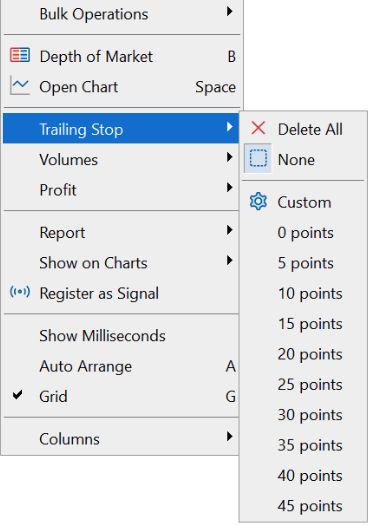
Keep an initial Stop Loss in place. The built-in trail begins placing or advancing the stop after profit in points reaches the selected distance. Check the position's S/L field and the Journal for a successful modification. MetaQuotes documents this activation behavior and that the trailing logic runs in the terminal.
When the desktop terminal is off, the last Stop Loss already sent to the server remains, but the local trail stops advancing. On mobile, a manual Stop Loss edit changes a price once. For the desktop trailing rule shown here, keep its terminal running and connected. Check the position controls supported by your mobile app and broker before relying on any separate automatic trail.
TradingView and Tradovate have different support
In a supported TradingView broker connection, open Trade and inspect the order ticket's exit choices. Select Trailing stop when available, enter its distance, and check whether the field is expressed in ticks, price or another supported unit. Confirm the accepted order type in the working-order list.
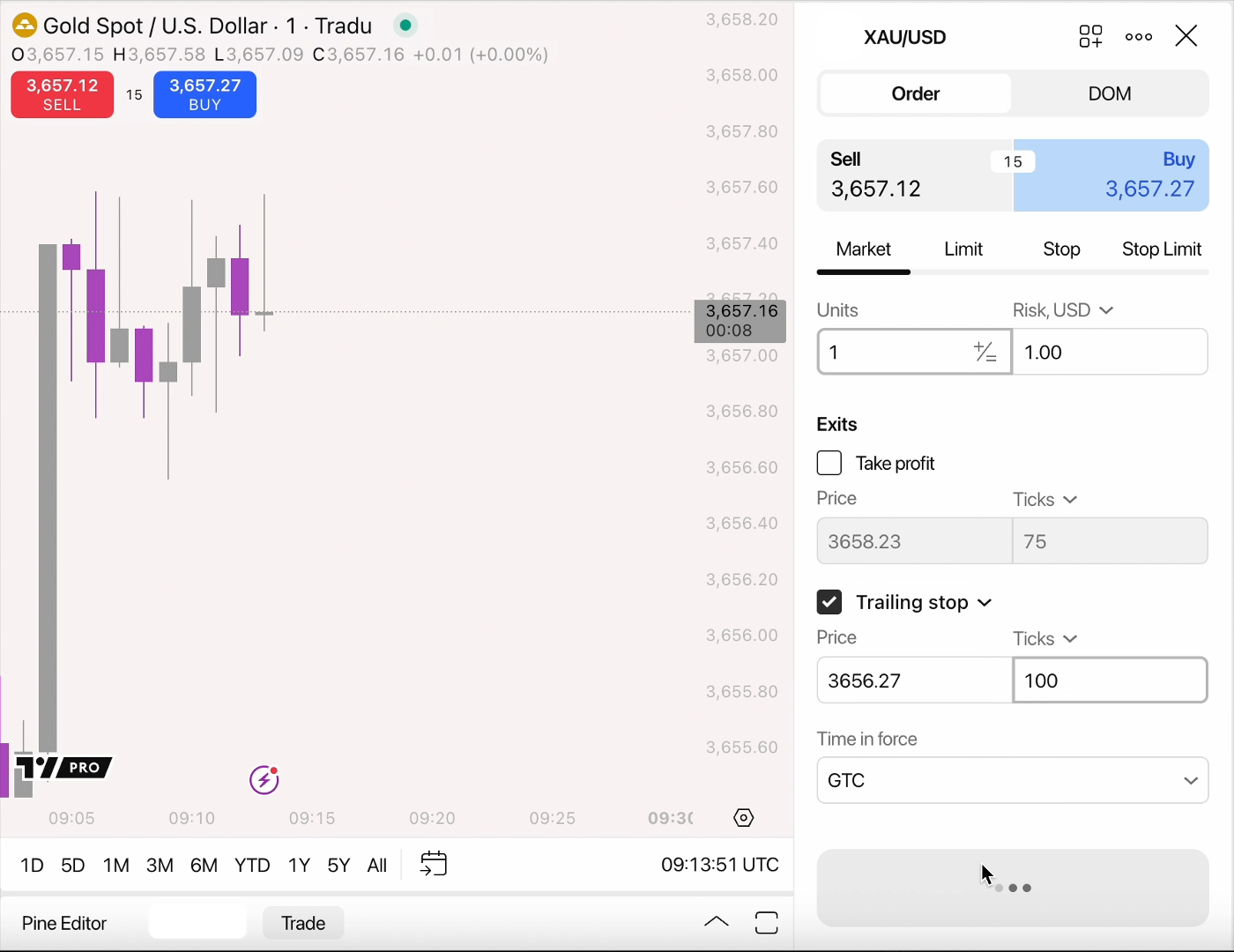
TradingView's trailing-stop guide requires a broker that supports the order type. A community indicator drawing an ATR line, a Pine strategy's historical exit and a broker-accepted trailing order are three different things. An alert alone also does not establish that an exit order has been accepted.
TradingView's current Tradovate integration does not support sending a Trailing Stop order. The restriction is stated in the integration's support page. Tradovate's own platform has trailing and ATM features; use that platform's controls when that is the function your connection provides.
For Tradovate AutoTrail, distinguish the initial stop distance, profit trigger and adjustment frequency. The trigger controls when the stop first advances; frequency controls subsequent adjustments. Check the selected unit before translating an example. The Tradovate platform walkthrough covers the surrounding chart and order workflow.
Size the initial risk before relying on a trail
A trailing rule can improve an existing stop after favorable movement. The initial loss can still occur before that improvement. Set position size from the original protective distance, contract multiplier and costs, with room for execution uncertainty.
For the 12-point MNQ example, one contract has $24 of price risk. If a hypothetical round-trip commission is $4 and the plan allows a further $2 for execution uncertainty, the estimated allowance is $30 per contract. A $90 budget accommodates three under those assumptions. The $4 and $2 are example inputs, not quoted brokerage fees or guaranteed maximum slippage.
The position sizing calculator connects stop distance with whole contract quantity. Change the instrument or distance and run the calculation again. A smaller trailing distance after activation does not justify increasing the original quantity halfway through a trade without a separate, tested rule.
Moving a stop to entry also leaves trading costs. A long at 20,000 stopped at 20,000 has zero price profit before commission; a worse fill adds a price loss. Treat breakeven as a price level unless your calculation explicitly includes costs and a realistic execution allowance.
A trade's trailing stop is separate from account drawdown
A prop firm's drawdown limit monitors the account under that program's rules. Your trade's trailing stop is an exit instruction. One does not replace the other. A trade can cross an account threshold before an order fills, even if the stop was intended to close earlier.
Keep a usable margin between planned trade risk and the account's permitted loss boundary. The EOD drawdown explanation separates the calculation of an account floor from intraday exposure. Use the actual rules for your company, product and account stage when checking that boundary.
A fixed profit target also changes the outcome being measured. If a target closes the trade before the trailing stop could act, the strategy is no longer testing an unrestricted trailing exit. Record both instructions and verify how any linked OCO orders cancel after a fill.
The risk reward ratio guide helps compare planned exits with the original risk. For a trailing system, also record the realized result in R. The maximum favorable excursion is useful context, but it is not the profit actually captured.

Compare HDP discounts
Lucid 30% · Tradeify 30% · TPT 50%.
See current offers ↗Eligible partner plans only.
A practical check before changing an exit rule
Write the rule in a form another person could reproduce: instrument, timeframe, initial stop, activation, distance, reference price, update schedule and order type. Then run it through a rising market, a falling market, a normal pullback and a fast move through the trigger.
In simulation, watch the accepted stop price change and compare it with the intended calculation. After an exit, confirm the position is flat and identify any remaining target or stop. If the expected modification fails, resolve the order state before adding another exit that might reverse the position.
Give the exit enough testing across the sessions you actually trade. Compare the same strategy with a fixed stop, a target-based exit and the chosen trail, including fees and execution assumptions. Keep the version that improves the result you care about under those conditions, rather than selecting the tightest distance that happened to survive yesterday's move.
Trailing stop FAQ
What is a trailing stop?
It is a stop whose trigger follows favorable price movement by a set amount or percentage and holds when the market reverses. The exact activation, update and execution rules depend on the order and platform.
How does a trailing stop loss work for a long trade?
After activation, a fixed-distance sell trail subtracts its distance from the highest tracked reference price. A new high can raise the trigger; a pullback leaves it unchanged. Reaching that trigger can submit the configured exit order.
What is the difference between trailing stop loss and trailing stop limit?
A trailing market stop submits a market order after triggering. A trailing stop limit submits a limit order. The first can fill at a worse price; the second can remain unfilled beyond its limit.
Is a trailing stop better than a fixed stop?
It changes the exit behavior. Trending movement can allow it to retain a position, while ordinary pullbacks can trigger repeated exits. Compare both on matched entries and costs across the sessions your strategy trades.
What does a 25% trailing stop mean?
For a long using a percentage of the tracked high, the trigger is 75% of that high. A $250 high produces $187.50. That can be below the entry price, so the percentage does not guarantee profit.
What is a good trailing stop percentage?
There is no universal percentage. Test it against the instrument, holding period and volatility, then measure net results and drawdown. Convert the distance into money so that the original risk still fits the position size.
How do you calculate an ATR trailing stop?
Multiply the selected ATR by the tested multiplier to obtain distance. A long candidate can be reference high minus distance, constrained by the previous stop so it only advances. A short uses the mirrored calculation.
Can an ATR trailing stop move backward?
A changing ATR can produce a wider candidate distance. For a one-way trailing rule, take the maximum of previous and new stop for a long, or the minimum for a short. Check the script's implementation.
How many ticks are 12 MNQ points?
With a 0.25-point tick, 12 points equals 48 ticks. At $2 per point, that is $24 for one MNQ before costs. The same point distance on one NQ is $240 before costs.
Will MT5 keep trailing when the desktop is closed?
The built-in desktop trail stops updating when its terminal is off. The last Stop Loss already sent to the server remains. Before the trail activates, keep an initial protective Stop Loss in place.
Can I use a trailing stop in TradingView?
It depends on the connected broker and supported order type. A chart indicator or historical strategy exit does not establish broker-order support. Inspect the ticket and confirm the accepted working order.
Does TradingView support trailing stops for Tradovate?
The current integration does not support sending Trailing Stop orders. Tradovate's own platform provides separate trailing and ATM functions. Use the controls supported by that connection and verify their activation and distance units.
Why did my trailing stop fill below its trigger?
A market stop's trigger starts an order; available liquidity determines the fill. Gaps, fast movement and spread changes can produce a worse price. A limit can constrain price while leaving the position unfilled.
Can an OHLC backtest reproduce a trailing stop exactly?
A single candle can hide whether its high or low came first. When the stop changes intrabar, that sequence affects the result. Record the simulator's execution assumptions and use appropriate lower-timeframe data where available.