
Tradeify Select Flex has a higher payout cap than LucidFlex on a current 50K account. That helps once you have enough profit to reach the cap. Before that point, both limit a request to 50% of the profit still in the account.
The purchase settings also matter. LucidFlex lets you choose whether to have a daily loss limit. Tradeify Select lets you pay for a higher evaluation consistency percentage, then choose Flex or Daily after passing. Two advertised “50K Flex” prices can therefore buy different conditions.
This comparison follows current standard 50K futures accounts from evaluation into the simulated-funded Flex stage. The Tradeify review and Lucid Trading review cover the other account families.
Lucid update, October 26:Flex and Daily now offer 40% or 50% evaluation consistency at different prices. Pro, Flex, Daily and Direct show current HDP pricing at checkout. DLL On accounts can request a payout as soon as all dashboard objectives are complete, including existing DLL On accounts. Daily allows multiple requests in one day, provided every request meets the payout requirements. Official announcement
Select 50% add-on: new-purchase Flex payout caps
For new Select purchases with the 50% evaluation-consistency add-on and Flex payouts, the per-payout caps are US$1,250 / US$2,000 / US$3,000 / US$4,000 for 25K / 50K / 100K / 150K. The 25K cap is unchanged; the other three fall by US$500. Existing accounts keep their current caps. Standard 40% configurations and Select Daily caps are unchanged. Flex still limits a request to 50% of current total profits, with all other payout conditions applying.
Match the purchase settings
Both firms charge a one-time evaluation fee, with no monthly account subscription or activation fee when you pass. Failed evaluations can mean another reset or purchase, and trading commissions still reduce your results. Optional data and software are separate parts of your budget.
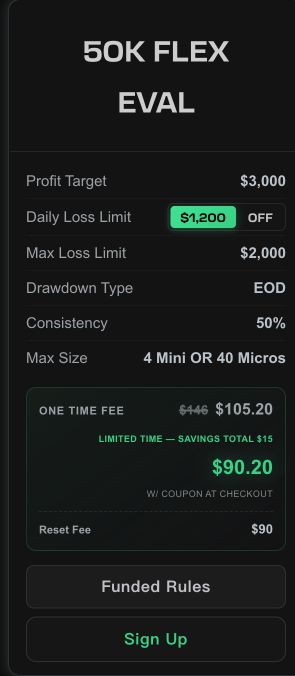
On LucidFlex, DLL On is cheaper and carries the daily loss limit into both evaluation and funding. Reaching that daily limit locks trading until the next session; reaching the maximum loss floor fails the account. DLL Off removes the daily limit in both stages. You cannot change the selection on an active account.
Select has no daily loss limit during its standard evaluation. Its base consistency requirement is 40%; the optional 50% version costs more. The official 50K base prices are $165 and $205 respectively. After passing either version, you choose the funded Flex or Daily policy. That funded-policy choice is permanent for the account.
| Configuration | Evaluation consistency | Daily loss setting | Current homepage display |
|---|---|---|---|
| LucidFlex, DLL On | 50% | On in evaluation and funding | $90.30 |
| LucidFlex, DLL Off | 50% | Off in evaluation and funding | $130.20 |
| Select, standard | 40% | No DLL in evaluation; Flex has none after passing | $116, rounded on the homepage |
| Select, 50% add-on | 50% | No DLL in evaluation; Flex has none after passing | $144, rounded on the homepage |
Offers change. Choose the same size, daily loss setting and consistency option before comparing the final total, then enter HDP on an eligible purchase. For a no-DLL comparison, use LucidFlex DLL Off against Select Flex. The cheaper Lucid DLL On configuration has an additional daily restriction.
Evaluation consistency affects when you can pass
Both 50K evaluations have a $3,000 profit target and $2,000 EOD maximum loss allowance. LucidFlex offers 40% and 50% evaluation consistency. The prices above show the 50% version, which can pass in two trading days; the 40% version needs at least three. Standard Select uses 40%, which needs at least three days; its paid 50% option permits a two-day path.
The calculation is largest profitable day divided by total net profit. A $1,500 best day is 50% of a $3,000 total. Under a 40% requirement, that same best day needs at least $3,750 total profit. Earning more on one day is not automatically a failed evaluation; it can mean you need more total profit before passing.
Lucid includes a consistency cushion, but it is not a fixed extra dollar allowance for every account result. Use the dashboard's percentage for your actual profit rather than treating an example amount as a daily target. The consistency guide explains the denominator and how a losing day changes it.
Evaluation profit does not become money available for a funded payout. After passing, start checking the funded account's own winning days, balance and rules.
What the funded Flex accounts have in common
Each payout cycle requires five winning days of at least $150 on these 50K accounts. You also need positive net profit in the applicable cycle. Old profit can remain in the balance while the new cycle is losing; that remaining balance does not excuse the new-cycle requirement.
Neither funded Flex plan has an ongoing consistency percentage or a separate payout buffer to build first. Both pay a 90% trader share. Their 50% withdrawal calculation uses profit above the starting account balance, subject to the request minimum and cap.
| Rule | Tradeify Select Flex | LucidFlex |
|---|---|---|
| Winning days per cycle | 5 days, at least $150 each | 5 days, at least $150 each |
| Minimum gross request | $250 | $500 |
| Maximum gross request | 50% of profit, up to $2,500 | 50% of profit, up to $2,000 |
| Trader share | 90% | 90% |
| Daily loss limit | None | As selected at purchase |
| Starting contract limit | 2 minis / 20 micros | 2 minis / 20 micros |
| Maximum scaled limit | 4 minis / 40 micros | 4 minis / 40 micros |
With $2,000 profit in either account, the 50% formula allows at most a $1,000 gross request, assuming all other conditions are met. Select's higher cap adds nothing at that balance. The cap difference starts to matter when the profit available supports a larger request.
A larger request leaves less room for the next trade
Suppose both accounts have reached $55,000, completed the required winning days and met every other payout condition. Their loss floors are locked at $50,100. These are hypothetical account results, not a forecast.
LucidFlex allows a $2,000 gross request, producing $1,800 for the trader before receiving charges. The account balance becomes $53,000, leaving $2,900 above the floor. Select Flex allows $2,500 gross, producing $2,250 cash and leaving $52,500 in the account, or $2,400 above its floor.
At those maximum requests, Select puts $450 more cash in the trader's hands and leaves $500 less room for future trading losses. You can request less than the maximum when you want to keep more room. The higher cap gives you that choice; it does not increase your trading profit.
The full gross request leaves the account, including the firm's share. Calculate the next trade from the post-deduction balance, not from the cash payment. The EOD drawdown guide explains why the current floor still applies during an open trade.
Contract limits can behave differently after a withdrawal
Both 50K funded Flex accounts start at two minis or twenty micros. Seeing four minis on an evaluation card does not mean the new funded account begins with that allowance.
LucidFlex reaches three minis at $1,000 simulated profit and four at $2,000. Its scaling tier updates at session end and can move down as the remaining profit falls, including after payouts. Select reaches three minis at $1,500 EOD profit and four at $2,000; the Select funded policy retains an achieved tier even if the balance later fluctuates.
A retained contract limit does not retain the same loss room. Select may still permit the larger quantity after a payout while the remaining balance can absorb a much smaller loss. Check both the permitted quantity and what your planned stop would cost.
Daily and instant-funded plans are separate comparisons
Select lets you postpone the Flex-versus-Daily decision until you pass. If you want daily requests, compare the retained buffer, new-profit calculation and daily cap before choosing. The Daily vs Flex guide and calculator covers that decision.
LucidDaily is a different account family from LucidFlex. Its funded drawdown and news restrictions should not be substituted for the Flex rules above. Likewise, LucidDirect and Tradeify Lightning start in simulated funding without an evaluation, but still require trading profit and payout eligibility. They are not a cheaper or faster version of the same Flex account.
Check your trading routine before buying
Lucid's inactivity policy requires trading that produces at least $1 net profit or loss within thirty calendar days. Tradeify requires a trade on each evaluation or simulated-funded account every Monday–Friday week and sends a warning before inactivity action. Neither means simply signing in to look at a balance.
Both Flex programs allow news trading, while execution risk and the existing loss floor remain. Standard Lucid Flex positions must be closed by 4:45 p.m. US Eastern Time; Tradeify also requires positions closed before 4:45 p.m. Check the holiday schedule for an earlier market close. A futures evaluation is not an overnight swing account.
For short-duration trades, Tradeify's funded payout test requires over half of the trades to last longer than ten seconds and over half of profit to come from those trades. Failing that test blocks a payout rather than automatically failing the account; it does not apply during evaluation.
Lucid instead flags an account when over half of profit comes from trades held five seconds or less. It then manually reviews the conduct. Confirmed bad-faith activity can lead to a warning; continued activity after warning can lead to forfeited profit or permanent restrictions. This policy applies to evaluation as well as funding. A “five versus ten seconds” label alone leaves out those differences.
For TradingView, choose the Tradovate connection at either firm. A Tradeify Rithmic account does not connect directly to TradingView. Your firm dashboard login, platform credentials, market data and any paid TradingView subscription are separate things to check.
Tradeify's FAQ requires logging in without a VPN or VPS; after normal login it permits VPS trading at your own risk. Use your own identity and confirm country eligibility before purchasing. A VPN does not make a restricted nationality or residence eligible, and multiple trading accounts do not require inventing separate customer identities.
Payout timing and Live selection
Lucid's Flex payout policy allows two business days for disbursement after approval. Tradeify's agreement describes payment normally within 24–48 hours after approval and deduction, with longer processing outside business hours. Its agreement also permits review until the next payout cycle and pauses processing limits during a compliance investigation. Neither is a guaranteed time for an international bank to credit your money.
LucidFlex's policy permits up to five payouts before the move to Live. Tradeify uses three approved payouts on one account or ten total since the relevant starting point as consideration benchmarks, but may select a trader earlier, later or not at all. You cannot plan an indefinite series of Sim payouts from either firm's maximum cap.
Tradeify's current Elite accounts start at $0, do not carry over Sim profit, and use an 80% trader share. The transition closes evaluations and Sim accounts; eligible paid-out accounts can become separate Live accounts. Live parameters and rewards are a different stage from the 90% Flex comparison above.
Which difference will you actually use?
If your expected gross requests are below $2,000, the 50K cap difference is unlikely to decide the choice by itself. Compare the purchase price at the daily loss setting you want, your evaluation's largest-day percentage and whether you trade often enough to keep each account active.
Select is useful if you want to choose the funded payout policy after passing, or want the option of a larger Flex request after building enough profit. LucidFlex lets you choose 40% or a higher-priced 50% evaluation consistency setting. Its DLL choice needs to be settled when purchasing.
Take your own trading records through those conditions before buying several accounts. A higher allowed withdrawal, faster advertised approval or larger contract limit is not evidence that your strategy will pass more often. For the broader Traditional Chinese comparison, see Tradeify 與 Lucid 怎麼選.
Check the final configuration with HDP
Select the account size and options first. Use HDP on eligible ordinary purchases and check the final price before paying.
HDPView Tradeify View Lucid Trading
A qualifying purchase through these referral links may earn 全職奶爸 a commission without adding to your price.
LucidFlex vs Tradeify Select questions
Are Lucid and Tradeify the same company?
No. They have separate accounts, verification, rules and payout reviews, even when both use Tradovate.
Does every account called Flex use 40% consistency?
No. LucidFlex evaluation offers 40% or 50%; standard Select evaluation uses 40% with an optional paid 50% version. Both funded Flex paths have no ongoing consistency percentage.
Does LucidFlex always have no daily loss limit?
No. Choose DLL Off for that configuration. DLL On is cheaper but carries the daily restriction into evaluation and funding.
Can I switch Select Flex to Daily later?
You choose after passing. Once selected, that funded account's policy cannot be changed. Another eligible account can have a different choice.
Must the five winning days be consecutive?
The policies require five qualifying days in the payout cycle, not five consecutive calendar days. Each must meet the account's daily threshold.
Is the minimum payout the same?
No. The current minimum gross request is $250 for Select Flex and $500 for LucidFlex.
Do I receive the full $2,500 Select cap?
That is the gross request limit. At the 90% trader share, a qualifying $2,500 request pays $2,250 before receiving charges.
Can old profit cover a losing new payout cycle?
Profit can remain in the balance, but the new cycle must still be net positive and complete its own qualifying days.
Can I trade four minis immediately after funding?
Both matched 50K Flex accounts start at two minis. Funded scaling determines when four become available.
Does keeping a higher contract tier preserve my drawdown room?
No. A withdrawal reduces the remaining balance even when a contract tier is retained. Position permission and remaining loss capacity are different limits.
Can I use TradingView with either firm's Rithmic account?
Select Tradovate for the direct TradingView connection. Tradeify explicitly states that its Rithmic accounts do not connect directly to TradingView.
Can I budget on receiving five maximum payouts?
No. Each request needs new eligibility, sufficient profit and approval; Live selection or an account failure can change the path before your planned schedule finishes.