

Lucid Trading offers four public futures plans: LucidPro, LucidFlex, LucidDaily and LucidDirect. Pro lets you pass an evaluation without a consistency percentage. Flex offers a choice of 40% or 50% evaluation consistency, then removes consistency and the payout buffer once funded. Both can be bought with or without a daily loss limit.
Flex is the first option worth comparing if your profitable sessions vary a lot in size and you can wait for five qualifying days. Pro is worth the extra comparison if you need its immediate full contract allowance or its one-day evaluation route. Daily adds a different choice: more frequent payout eligibility, with a choice of funded drawdown when the evaluation uses EOD.
A Flex account can qualify for a withdrawal before it has earned the amount Pro needs to retain as a buffer. Taking that withdrawal also locks the Flex loss floor, so the amount left to trade with can be much smaller than the original drawdown allowance.
Lucid update, October 26:Flex and Daily now offer 40% or 50% evaluation consistency at different prices. Pro, Flex, Daily and Direct currently receive 35% off with HDP. DLL On accounts can request a payout as soon as all dashboard objectives are complete, including existing DLL On accounts. Daily allows multiple requests in one day, provided every request meets the payout requirements. Official announcement
What you pay for, and when the trading becomes live
A standard Lucid evaluation is simulated. Passing gives access to a simulated funded account, where eligible trading results can lead to real payouts. LucidDirect starts at that simulated funded stage. A later LucidLive account trades live capital. These are different stages, even when the platform shows the same familiar futures symbols.
The 50K label is not $50,000 deposited into your bank account. On the standard 50K evaluation routes, the initial maximum loss allowance is $2,000. Your purchase fee pays for program access; another attempt or an optional platform service can cost more. Several failed attempts are several real expenses, despite the simulated trading.
Lucid's Terms of Use identify Lucid Trading Group LLC as the operating company. Account access, identity checks and any later payout request are handled through its program and payment providers.
Standard accounts use a one-time purchase rather than a recurring monthly evaluation subscription. Passing an evaluation does not add an activation fee. A failed evaluation can be restarted with a separately purchased reset; a reset is not a free second attempt. The account-fee policy separates those charges.
For an existing failed evaluation, use the Lucid Trading reset fees and reset-versus-new comparison. Check the 30-day window and matching settings, then compare the current quotes with the eligibility and cost checker.
Compare the four standard 50K routes
| Plan | Evaluation | Funded drawdown | Funded payout conditions |
|---|---|---|---|
| LucidFlex | $3,000 target; 40% or 50% consistency | $2,000 EOD; optional DLL | Five days of at least $150; positive cycle profit; 50% of current profit, capped at $2,000 per request |
| LucidPro | $3,000 target; no consistency percentage | $2,000 EOD; optional DLL | 40% consistency; $500 cycle profit; retain $52,100 buffer balance; $2,000 first-request cap |
| LucidDaily | $3,000 target; evaluation drawdown and consistency depend on configuration | $2,000 TDD or eligible EOD; optional DLL | Positive cycle profit; withdraw profit above $52,100; no fixed per-request dollar cap |
| LucidDirect | No evaluation | $2,000 EOD; $1,200 initial DLL | 20% consistency; first-cycle $3,000 profit goal; $2,000 cap for requests 1–3 |
These simulated funded plans use a 90% trader share and a $500 minimum request. Each request needs to meet that plan's full conditions, including the available profit and applicable cap.
The other standard evaluation sizes are 25K, 100K and 150K. Their respective profit targets are $1,250, $6,000 and $9,000, with initial maximum loss allowances of $1,000, $3,000 and $4,500. Direct has its own size-dependent loss allowances and payout goals. Use the futures PropFirm selector to compare a particular size and stage rather than extending the 50K numbers to every account.
LucidFlex vs Pro: where the consistency rule appears
Pro evaluation has no consistency percentage and can be passed in one trading day. Funded Pro then requires its largest profitable day to be no more than 40% of the payout cycle's total net profit. You also need the cycle profit goal, available money above the buffer, and enough to meet the minimum request.
Flex evaluation offers 40% or 50% consistency, selected when purchasing. If one session provides too much of the total, the account needs more total profit before it qualifies. A large profitable day does not itself fail the account. The percentage describes the distribution of profit across days; it is not a maximum order profit or an instruction to give money back to the market.
Use the Lucid Trading consistency calculator and plan limits to check completed daily net results against the selected Flex or Daily percentage, Pro version or Direct payout cycle. The worksheet keeps the strict baseline separate from the provider’s cushion.
After passing Flex, that consistency requirement disappears. Each payout cycle instead needs five separate days meeting the size-dependent daily profit threshold, plus positive net profit for the cycle. Those days do not have to be consecutive. Losing days still reduce net profit, even though they do not erase previously completed qualifying days.
This fits the approach of making more when a useful move develops and trading smaller on other sessions. It does not make the daily threshold a sensible profit target for every session. Position size still has to fit the remaining loss allowance; chasing the last few dollars of a qualifying day can cost an account.
A Flex payout can qualify before Pro, then reduce your risk room
Assume a new 50K simulated funded account earns $1,200 on one day and $200 on each of four other days. All amounts are net of trading costs. Total profit is $2,000 and the balance is $52,000. This is a hypothetical example, with verification and other trading conditions satisfied.
Flex has five days above its $150 qualifying threshold and positive cycle profit. Half the current $2,000 profit is $1,000, below its $2,000 cap and above its $500 minimum. A $1,000 gross request produces a $900 trader share.
Pro cannot pay from the same result. Its balance has not cleared the $52,100 buffer and left at least $500 to request. Its largest day is also $1,200 out of $2,000, or 60%. Holding that best day constant, the 40% requirement would need $3,000 total cycle profit. Both the buffer and consistency conditions need to be satisfied.
50K Flex · hypothetical first payout
$2,000 profit
Balance: $52,000
Full $1,000 deducted
Account retains $51,000
Locked loss floor: $50,100
Remaining trading room: $900
The Flex withdrawal brings another change. Requesting it locks the maximum loss floor at $50,100, even though this example has not reached the ordinary $52,100 trail balance. After the full $1,000 deduction, the account holds $51,000 and can lose only $900 before touching that floor.
Having no payout buffer lets you request earlier; it does not preserve the original $2,000 loss allowance after withdrawing. Use the trading calculators to check gross deduction and remaining room separately. The Flex drawdown policy describes the request-triggered lock.
For later cycles, Flex measures the percentage against profit currently left in the account, while also requiring new qualifying days and positive new cycle profit. Previous retained profit and this cycle's net profit are different numbers. A $1 positive cycle does not create a $500 request if the account lacks enough accumulated profit.
Use the LucidFlex payout limits and cycle calculator for all four account sizes. It separates retained profit from new cycle net profit, checks the entered qualifying-day count, and shows the gross deduction, 90% share and remaining gap above the loss floor.
The LucidPro payout limits and cycle calculator separates the first and later caps from the required buffer, new-cycle profit goal and 40% consistency check. Enter the actual dashboard loss floor to see the balance left after the full gross deduction.
Optional daily loss limits and the price you compare
Pro and Flex let you choose DLL On or Off when buying the evaluation. The setting carries into the funded account and cannot be changed on that active account. DLL On costs less. DLL Off removes the daily loss cap, while the maximum loss floor continues to apply.
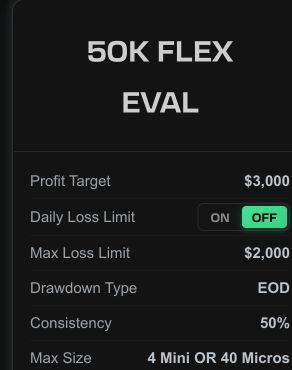
On 50K, the DLL-On starting limit is $1,200. Reaching the DLL pauses trading until the next session, provided the account has not also reached its maximum loss floor. That floor is a hard boundary. Switching off DLL does not turn the hard boundary into a soft restriction.
For DLL-On funded Pro, the daily limit later changes to 60% of the highest end-of-day profit once the applicable trail threshold is exceeded. It can rise with new closing-profit highs and does not shrink when the account later draws down. This is a funded daily-limit calculation, not an additional checkout switch. The Pro DLL rules give the stages.
Compare prices with the same account size and DLL setting selected. A lower advertised Flex price may have DLL enabled, while the Pro price beside it may have DLL disabled. Confirm the new-purchase total and reset price separately, then enter HDP for the eligible current offer. A promotion is useful only after the configuration is the one you wanted.
EOD protects against a rising intraday floor, not an existing floor
Pro and Flex use an end-of-day trailing maximum loss limit. A temporary open-profit high does not immediately lift their loss floor. A new highest closing balance can lift it at session end, until the locking condition is reached.
The existing floor still applies during an open trade. Touching it fails the account; recovering before the close does not undo the breach. This distinction matters when a position moves against you. EOD changes when the floor is recalculated, while the account must stay above the current floor throughout the session.
Daily funded accounts can use intraday trailing or, when the evaluation uses EOD, the new funded EOD option. Intraday trailing follows unrealized equity highs; the floor does not fall when gains are given back. Daily now offers funded EOD when EOD is selected for the evaluation. Evaluation consistency is 30% or 40% with this configuration; intraday evaluations cannot initially select funded EOD. With funded EOD and the daily loss limit on, eligible traders can request multiple on-demand payouts per day. Check the dashboard for eligibility on existing orders.
Use HDP for the current 35% offer, or buy 5 accounts together for an extra 5% off the discounted total. Confirm the selected configuration and order total at checkout. Reset fees are separate.
Both the withdrawal deduction and the market can reduce your remaining distance from the floor. Recalculate position size after a withdrawal instead of continuing with the evaluation quantity because the account still says 50K.
Daily and Direct solve different problems
Daily lets a qualifying trader request profit above the buffer without a fixed per-request dollar cap. On 50K, retain $52,100, meet the $500 request minimum and have positive net profit since the previous payout. If the last withdrawal used all profit above the buffer, the next cycle needs enough new profit to make another minimum request.
Daily funded accounts also prohibit holding or opening positions from one minute before through one minute after a high-impact USD news release. Both conditions matter: high impact and USD. Violating that window is a hard breach. The Daily funded rules define the restriction.
Daily's 50K maximum simulated profit in one day is $8,000, a live-transition trigger rather than a withdrawal cap. Its Live settlement is also separate: the buffer funds starting live drawdown, while simulated profit above it may be paid after the broker checks, capped at $15,000 across all Daily accounts. That is a transition settlement cap, not $15,000 per account or a lifetime Daily payout limit.
Direct skips the evaluation but keeps a profit goal and 20% consistency for each payout cycle. The 50K first goal is $3,000; subsequent goals are $2,500 of new cycle profit. Requests 1–3 are capped at $2,000, then requests 4–5 at $2,500. Paying for Direct buys a different starting stage, not an immediate withdrawal.
Contract size, platforms and trading costs
Funded Flex starts with a scaling limit. A 50K account begins at two minis or twenty micros, moves to three or thirty at $1,000 simulated profit, then four or forty at $2,000. Tiers update at session end, not when an open position briefly crosses a profit threshold. Withdrawals can lower the tier again.
Pro has no funded scaling plan and provides its full plan allowance immediately. If your strategy needs a position larger than Flex's opening tier, that can affect the choice. Otherwise, Flex's smaller initial allowance may not constrain your actual orders.
Choose the CQG/Tradovate connection for the separate TradingView platform, Tradovate or NinjaTrader. Rithmic supports platforms including Tradesea, Quantower, Sierra Chart and Bookmap. The supported-platform list separates the connections. A Tradesea chart does not make the account a Tradovate-connected TradingView account.
For the step-by-step connection, use the Lucid TradingView setup and login troubleshooting guide. It covers the first desktop login, Demo selection for simulated accounts, and separate checks for access, data and contract errors.
For the device, data and switching checks behind this choice, see how to choose between Rithmic and Tradovate.
Lucid's approved-products table quotes commission per side. MNQ and MES are $0.50 per side; NQ and ES are $1.75. A one-contract round trip therefore has $1.00 or $3.50 of that listed commission respectively. Ten micros have the same index exposure as one corresponding mini, but ten separate commission charges. Optional data, software and payment costs are separate.
Use the Lucid commissions and round-trip calculator for the complete 34-symbol schedule, your own trade quantities and a net-result check.
Gold, crude oil, currency and agricultural futures have different rates, and not every exchange-listed contract is approved. Check the products and commissions table for the actual symbol. These are futures contracts, separate from a platform's spot crypto, stock or forex-CFD products.
What happens at the fifth payout and after a Live invitation?
For current Pro, Flex and Direct, payout five is the maximum simulated payout level, not a guaranteed minimum before a move. Lucid can review traders earlier based on performance, lifetime payments or a previous Live history. Eligible funded accounts must have received at least one payout to become corresponding Live accounts.
Ordinary Live accounts begin at $0, with a size-dependent starting drawdown, EOD trailing and no DLL or consistency requirement. All remaining simulated accounts close when the trader moves Live or chooses cashout. A household cannot continue simulated trading while a household member trades Live.
The current Live structure includes a cashout choice and a 24-hour response window after the move email. Read that notification promptly. The current repeatable bonus requires both its profit target and twenty qualifying trading days; it is not an automatic monthly payment. A qualifying day needs a trade and at least $1 positive or negative net result after fees.
Daily follows its own transition settlement, including the aggregate cap on simulated profit above its buffer. Confirm any bonus entitlement in the terms of the Live move before including it in expected proceeds. LucidMaxx is invitation-only and has a separate evaluation, Pre-Live stage and static-floor Live structure. It is not a fifth public plan you can simply select instead of Flex. The Maxx program sets out that separate path.
The LucidLive rules, scaling and bonus checker separates the current standard Live stage from simulated funding. Check the exchange-specific position tier, the separate bonus-profit and trading-day goals, and the amount in the Cash Out notification before deciding.
Reviews, verification and receiving your money
Lucid's public feedback includes successful payout reports as well as complaints about access, support and verification. Its Trustpilot profile displayed a 4.4 numeric score when checked. The site invites customer reviews. Treat individual reviews as reported experiences, not proof of what will happen to your own order.
Check citizenship and residence eligibility before paying, and complete the verification requested for your own profile. Being able to place an order does not prove every identity or payment-provider check is finished. If your verification fails, resolve that result through official support before adding another paid account.
For approved withdrawals, Plaid provides a US bank option; WorkMarket serves US and international traders. Crypto availability depends on region and the options offered to the profile. Do not plan around someone else's payment method without checking your own eligibility.
Request submission, Lucid approval, payment-provider receipt and bank arrival are separate events. The payout policies describe disbursement within two business days after approval. A reported five-minute payment does not establish a five-minute international bank-transfer promise. The Lucid payout methods guide explains receiving options, timing and delayed-transfer checks.
Operating rules to check before running several accounts
For the actual setup, use the Lucid Tradovate and Rithmic copy trading guide. Its group allocation worksheet separates the combined ticket from each account’s contracts, checks entered caps, and explains the native ATM, mobile and group-removal limits.
Per household, evaluation and funded accounts share a ten-account total, with no more than five funded accounts. Different funded plan types count together. Buying several accounts multiplies purchase costs and the consequences of a copied loss; each still needs to satisfy its own payout conditions.
Automated systems and trade copiers are permitted when they comply with the trading rules. Opposing positions across accounts, including correlated contracts across firms, are prohibited. The hedging policy includes long ES in one account against short NQ in another. A copier error does not make the resulting positions exempt.
Microscalping is flagged when more than half of profit comes from trades held five seconds or less. Lucid then reviews the activity; this is not a universal five-second minimum holding period for every individual trade. HFT and exploiting simulated fills or system errors are also prohibited.
Pro, Flex and Direct simulated positions close by 4:45 p.m. Eastern Time, with trading resuming at 6 p.m. on ordinary reopening days. Holidays can close earlier. Live closing times differ by connection: 4:45 p.m. for Tradovate and 4:15 p.m. for Rithmic. Use the actual session schedule when converting to local time.
No monthly rebilling does not mean an unused account stays forever. Within thirty calendar days, the account needs trading that produces at least $1 of realized positive or negative net result. Logging in alone does not satisfy the inactivity rule.
Which Lucid route is worth comparing first?
Flex is a useful starting comparison for a trader who wants EOD drawdown, no funded consistency percentage and no fixed payout buffer, and can accumulate five qualifying days. Choose its DLL setting deliberately. The dedicated LucidFlex guide in Chinese goes further into payout cycles and sizing.
Before choosing, apply those requirements to a run of completed trading sessions, including the losing days. Check which days qualify, whether the best day passes consistency and what a withdrawal leaves above the loss floor. The main Lucid guide in Chinese provides the original series navigation, signup instructions and broader account details.
Choose your Lucid settings, then use HDP
Select the plan, account size, connection and DLL setting that fit your trading. Enter HDP for the eligible current offer and confirm the final total before paying.
HDPA qualifying purchase through this referral link may earn 全職奶爸 a commission without adding to your price.
Lucid Trading review FAQ
Is Lucid Trading a monthly subscription?
Standard trading accounts use a one-time fee, with no automatic monthly rebilling. Resets and optional services are separate purchases. The inactivity rule still applies while you work toward passing.
Does LucidFlex have a daily loss limit?
You choose DLL On or Off when purchasing the evaluation. The choice carries into funding. On a 50K account, DLL On starts at $1,200; Off removes that daily limit while retaining the maximum loss floor.
Can Pro pass in one day and pay out the next?
Pro can pass evaluation in one day, but the funded payout cycle has its own 40% consistency, profit and buffer requirements. Evaluation profit does not become a funded withdrawal balance.
Do Flex's five profitable days have to be consecutive?
No. Each must meet the required daily profit threshold within the current payout cycle. Losing days affect net profit, and approved payouts reset the qualifying-day requirement.
Can I withdraw half of a 50K account?
The Flex percentage applies to profit, not the full $50,000 starting balance. Its size-dependent cap and $500 minimum also apply. An account with $2,000 profit does not support a $25,000 request.
Does a Flex withdrawal change the loss floor?
Requesting a payout locks the floor at the starting balance plus $100. Account deduction uses the gross request, so calculate remaining room after that deduction rather than subtracting only the 90% cash you receive.
Does choosing EOD make Daily funded use EOD?
Only if funded EOD is also selected. An EOD evaluation permits the new funded EOD option; an intraday evaluation cannot initially select it.
Can I trade news on Lucid?
Pro, Flex and Direct permit news trading. Daily funded accounts require you to be flat from one minute before through one minute after high-impact USD releases. Orders during volatile periods still face execution and loss-limit risk.
Will I definitely receive five simulated payouts?
No. Five is the maximum payout level for current Pro, Flex and Direct. The risk team may move a trader earlier. A purchase should not assume five guaranteed maximum withdrawals.
Does every Live account have a repeatable bonus?
Ordinary Pro/Flex/Direct Live and the separate new Maxx program have their stated bonus conditions. The bonus is paid separately and has its own profit and trading-day requirements.
Can I trade on TradingView?
TradingView is supported through the CQG/Tradovate connection. Rithmic supports a different platform list, including Tradesea. Select the compatible connection before purchasing.
Can I combine Pro, Flex and Direct accounts?
Yes, within the household limits: ten evaluation and funded accounts combined, with at most five funded accounts. Different funded plan names do not each create a separate five-account allowance.
Will a five-second stop-out automatically fail the account?
The microscalping policy uses the proportion of profit from very short trades to flag activity for review. It does not state that every individual trade closed within five seconds automatically fails. Prohibited manipulation remains prohibited.
Can I refund an account I have already traded?
The refund policy excludes accounts that have been traded. An unused account may be considered at the company's discretion; not placing an order is not a guaranteed refund right.