FUTURES BASICS · By Yang
For the standard CME Globex session in NQ, MNQ, ES and MES, the trading week starts Sunday at 5:00 p.m. Chicago time and ends Friday at 4:00 p.m. Chicago time. The daily break is 4:00–5:00 p.m. CT. In New York time, those clocks are one hour later: a Sunday 6:00 p.m. opening, Friday 5:00 p.m. close and daily 5:00–6:00 p.m. break. Holidays and an expiring contract can change the schedule.
The practical difficulty is identifying which clock and which session a page describes. A chart can display Taipei time, an exchange calendar can use Chicago time, and a prop firm can require an earlier exit in New York time. All three can describe the same position. Write down the product, calendar date and time zone before deciding whether you can trade or continue holding it.
Futures trading hours: the normal CME index session
The following schedule applies to the normal electronic session for the four U.S. equity-index contracts named above. CT means the local time in Chicago; ET means the local time in New York. Both cities change their clocks for U.S. daylight saving time, so the one-hour difference between them stays the same.
| Event | Chicago time, CT | New York time, ET | What it means |
|---|---|---|---|
| Weekly opening | Sunday 17:00 | Sunday 18:00 | Matching resumes for the new trading week. |
| Daily close before maintenance | 16:00 | 17:00 | The normal trading session ends. |
| Daily maintenance break | 16:00–17:00 | 17:00–18:00 | No continuous matching during the break. |
| Next evening opening | Monday–Thursday 17:00 | Monday–Thursday 18:00 | The next session begins after the daily break. |
| Weekly closing | Friday 16:00 | Friday 17:00 | The weekend closure begins; there is no normal Friday evening reopening. |
| U.S. cash-equity core session | 08:30–15:00 | 09:30–16:00 | A separate reference window within the longer futures session. |
The official NQ contract specifications list the Globex hours separately from ClearPort and other trading mechanisms. Use the section for the way you actually trade. A later reporting window elsewhere on the page does not extend normal outright Globex matching.
“Nearly 23 hours a day” is useful shorthand for this session structure. It does not mean every futures contract follows one timetable or that trading continues through the weekend. Cryptocurrency contracts, agricultural markets and products on other exchanges need their own schedule. Start with the exact exchange and contract rather than applying an index-futures table to an unrelated instrument.
NQ and MNQ also remain different order books even when their normal session clocks match. Their position exposure belongs in a separate calculation. The MNQ vs NQ comparison explains the contract values, sizing and cost differences. A shared opening time does not make one contract of each the same trade.
Convert the date as well as the time zone
A Chicago evening is already the following morning in Taiwan. That date change explains why a Sunday U.S. opening appears on a Monday chart in Taipei, and why Taiwan can still have index-futures trading early on Saturday. The exchange has not added a separate Saturday session; it is still Friday in Chicago.
Use named zones such as America/Chicago, America/New_York and Asia/Taipei when setting a calendar or a date-aware tool. A fixed “UTC−5” label cannot represent New York for the entire year. EDT is UTC−4 and EST is UTC−5. The broader ET label follows whichever offset applies on that date.
| Normal event | When Chicago observes daylight time | When Chicago observes standard time |
|---|---|---|
| 17:00 CT session opening in UTC | 22:00 UTC, same date | 23:00 UTC, same date |
| 17:00 CT session opening in Taipei | 06:00, next date | 07:00, next date |
| 16:00–17:00 CT break in UTC | 21:00–22:00 UTC | 22:00–23:00 UTC |
| 16:00–17:00 CT break in Taipei | 05:00–06:00, next date | 06:00–07:00, next date |
| 09:30 ET cash opening in Taipei | 21:30, same date | 22:30, same date |
For a dated example, the Sunday opening on October 25, 2026 at 17:00 Chicago time converts to Monday, October 26 at 06:00 in Taipei. The opening one week later, November 1 at 17:00 Chicago time, converts to Monday, November 2 at 07:00 in Taipei. The Chicago opening clock is unchanged; the UTC and Taiwan equivalents move by an hour.
NIST's daylight saving time rules place the 2026 U.S. changes on March 8 and November 1. Use the applicable year's dates when planning further ahead. Taiwan does not make the corresponding seasonal clock change.
GMT and London time need separate treatment too. GMT is UTC+0; London uses British Summer Time during part of the year. The U.S. and U.K. change on different weekends. For example, a 17:00 Chicago clock time is 23:00 in London on October 23, 2026, but 22:00 on October 26. Selecting Europe/London for the actual date handles that temporary mismatch.
When someone asks for “futures trading hours EST,” clarify whether they mean fixed Eastern Standard Time or the current New York clock. Many traders use EST casually throughout summer. For a trading reminder, use New York's named time zone and retain the date; the calendar can then apply the seasonal offset correctly.
Convert a standard session clock
Choose the event's Chicago calendar date and your display zone. This converts an assumed clock time; it does not check holidays, weekends, incidents or account permissions.
A trading day can begin on the previous calendar evening
The session's trade date is a label used for trading and processing. It is not necessarily the date printed on your local wall calendar when the session opens. On an ordinary week, Sunday evening starts the session associated with Monday's trading date. Monday evening starts the next one.
Imagine two trades entered on Tuesday in New York: one at 01:00 and another at 19:00. The first belongs to the session that opened Monday evening. The second belongs to the session that opened Tuesday evening. Grouping both under one local calendar date can therefore give a misleading daily result.
This distinction matters when reviewing your journal, comparing a platform statement and counting qualifying program days. Save the entry timestamp, its zone and the platform's session or trade-date label. If two reports disagree, those fields let you reconcile the difference without assuming that a trade disappeared.
A local midnight also does not automatically force every position to close. Whether you may hold it depends on the account's permitted session and its actual cutoff. A position opened in the evening and closed the following afternoon can remain inside one continuous session. Crossing a maintenance break or a weekend is a different question.
Holiday processing can make the labels less intuitive. Read the trade date displayed beside the specific calendar event instead of generating one from a simple weekday rule. A program's qualifying-day requirements can add another condition beyond the exchange trade date.
Find the exact contract and date in the CME calendar
Open the CME trading-hours calendar and select Full Calendar. Choose the intended Chicago calendar date in Date. Enter the product code in Search by product name or globex code, keep Futures selected for a futures contract, and read the matching product row beneath the relevant date column.
Search results can contain closely related codes. In the demonstrated NQ search, the calendar returns the outright NQ contract alongside NQT, NQQ and NQX products. Match the code and full product name. The word “Nasdaq” appearing in a row is not enough to identify the instrument in your order ticket.
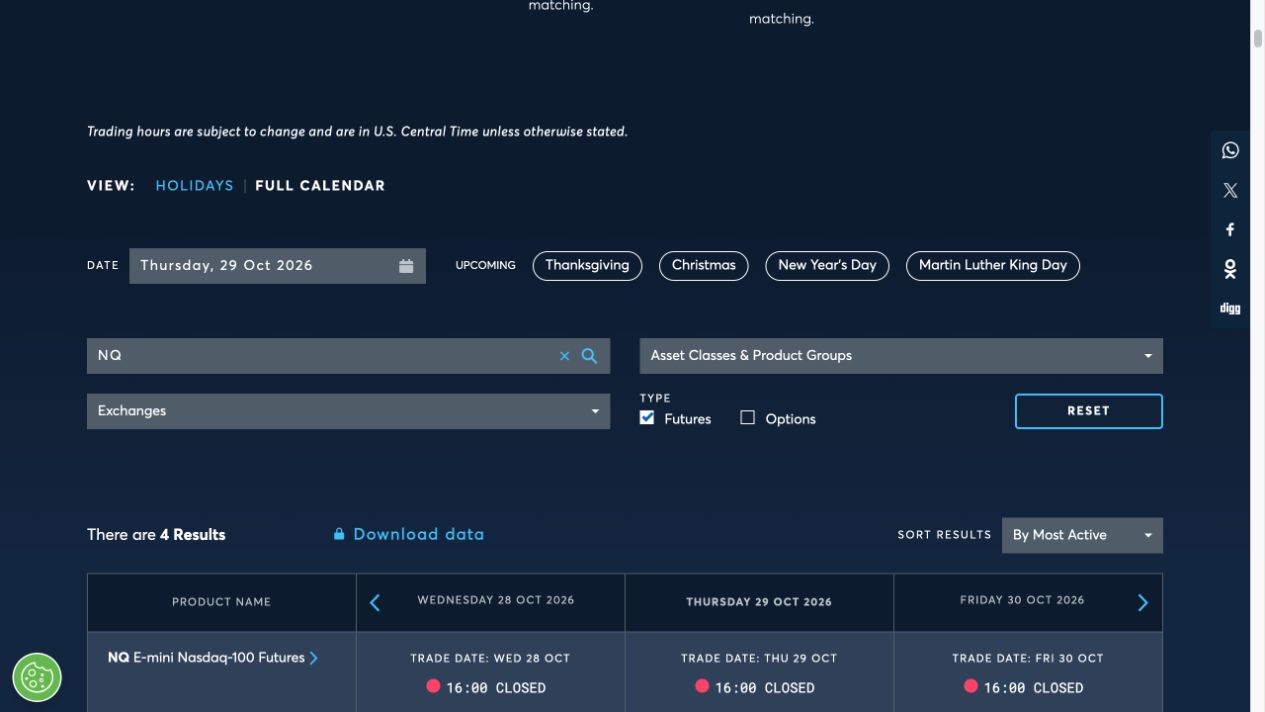
The example below shows the NQ row for October 28–30, 2026. It displays a 16:00 CT close, then a 16:45 CT preopen and 17:00 CT opening on the applicable evening. The trade-date labels change with the new session. These are dated examples of reading the calendar, rather than a live statement that the market is open now.
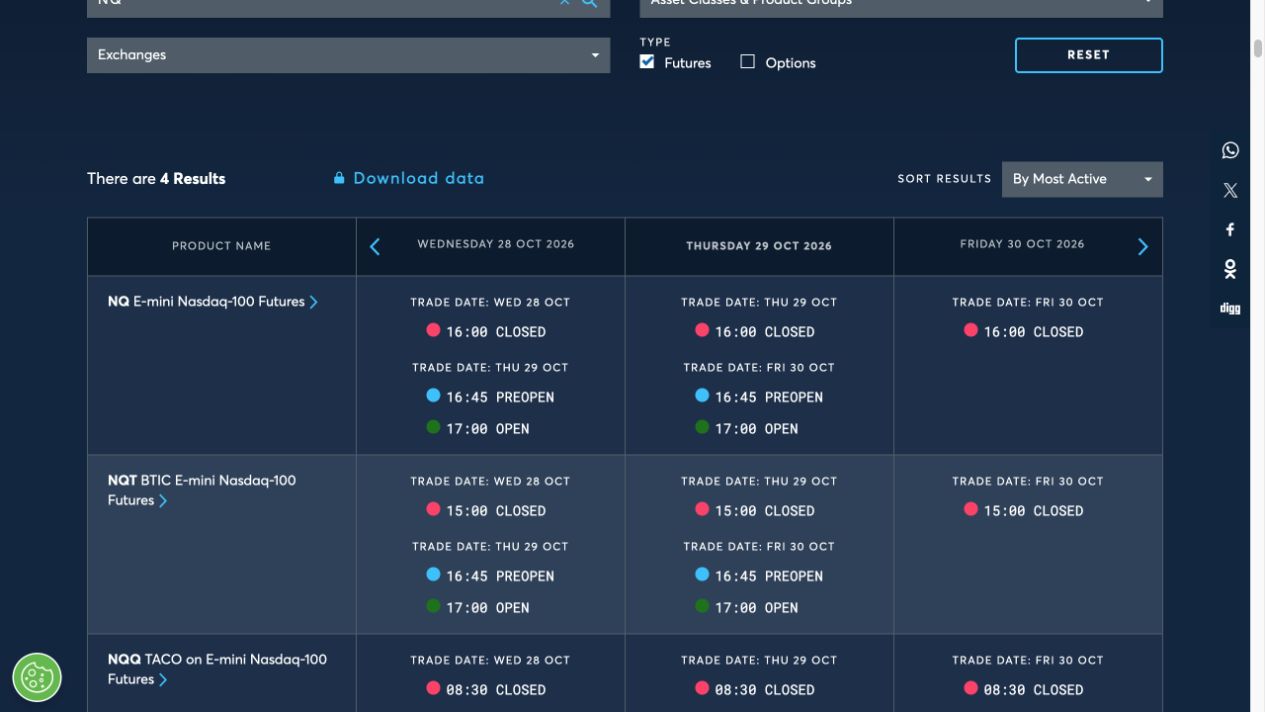
PREOPEN is not a trading fill. CME describes it as an order-entry phase without matching. OPEN begins the continuous matching phase. A platform accepting an order during preopen therefore does not establish that the order has traded. Check the accepted order state and the execution report separately.
PAUSED, PCP and CLOSED also have different meanings. PAUSED permits cancellation without matching. PCP has specific GTC/GTD order handling. CLOSED marks the final close for that date and removes the applicable day/current-date orders. Use the state definition beside the calendar rather than assuming every non-open period has the same order permissions.
Record the full code, chosen date, displayed time zone and the state you need to act on. If you are setting an exit alarm, distinguish the end of matching from a later processing or reporting event. Check the following date column as well when an evening session crosses into the next trade date.
Read a calendar column from top to bottom. A Thursday column can first show the end of Thursday's session, then show the evening events associated with Friday's trade date. Seeing Friday's label inside that Thursday column is therefore possible. Check the calendar date above the column and the trade date beside the event; they answer different questions.
The displayed time also belongs to a particular product row. NQ and a Nasdaq-related basis product can have different closing events in the same column. Copying a clock from the next row down can create an error even when the date and zone are correct. Keep the code attached to the time when saving a reminder or screenshot.
For a missing quote, work through the same fields before changing your strategy or placing another order. Verify the exchange, exact expiry, data entitlement and matching state. A disconnected feed, a closed market and an inactive contract can all produce a quiet chart, but require different fixes.
Holiday hours require a date and a product
A U.S. holiday name does not specify one opening or closing time for all futures. An equity-index contract can have a shortened schedule while a different product group has another sequence. Stock-exchange closures, futures matching, settlement and clearing are related schedules with different purposes.
Use the calendar's Holidays view for the holiday overview, or keep Full Calendar selected and choose the date and contract. Read the relevant state transitions and any applicable Holiday Notes. Repeat the check for the following session if you plan to return after the early close.
CME says holiday schedules can change and are generally finalized around two weeks before the holiday. A calendar captured months earlier is useful for planning but deserves another check near the trading date. Keep the official calendar link in your preparation routine rather than relying on a screenshot from a previous year.
Do not substitute a stock-market early close for the futures contract's own time. The NYSE core equity session is 09:30–16:00 ET on a normal full day, as listed in its trading information. That cash-market window does not define the entire Globex session or override a futures holiday notice.
The opening range breakout guide uses the normal 09:30 New York cash open as a strategy reference. It explains which candles form a fixed opening range and why that setup clock differs from the broader futures trading session.
Also check the account provider's announcement. A broker can change reduced intraday margin eligibility, and a funded program can impose an earlier holding cutoff. Put the applicable deadline in the same zone as your exchange calendar so that you can compare the two directly.
If the program notice and exchange schedule appear inconsistent, resolve the exact product, date and account scope before opening a position. A general early-close example cannot establish permission for every future holiday. The useful result is a verified session for the account you will actually use.
A prop firm's position deadline can come before the exchange close
The exchange determines when matching is available. Your broker or prop firm determines which of those hours your account may use and how long it may hold a position. Seeing a moving NQ price after your firm's cutoff does not extend your holding permission.
For example, Tradeify's permitted-times rule requires positions to close by 16:45 ET on regular days, before the normal 17:00 ET exchange close. Its rule lists 12:59 ET for holiday shortened days and directs traders to the applicable holiday announcements. The policy applies to evaluation, simulated funded and live accounts.
Under that rule, holding from 20:00 Monday to 14:00 Tuesday is within the same session. Holding through the daily close into the next session is prohibited. This is why “no overnight” needs the company's actual definition: calendar midnight and the session boundary are different events.
For the regular-day 16:45 ET deadline on October 29, 2026, the equivalent is 20:45 UTC or 04:45 the next morning in Taipei. On November 2, after the U.S. clock change, that same New York deadline is 21:45 UTC or 05:45 the following morning in Taipei. It remains fifteen minutes before the normal exchange close in each case.
Tradeify also states that its automatic closure does not itself fail the account, while warning that the fills can be unfavorable. Treat that mechanism as the provider's handling of a remaining position. Build your own exit process around the required deadline instead of assuming the automatic fill will equal the last chart price.
Before the cutoff, check the position quantity and any working entry orders. A flat position does not mean a resting entry cannot open new exposure later if the platform leaves it active. Use the provider's actual order-handling rules and confirm the final position and order state on the connected account.
The Tradeify review covers the account choices and other rules. Each company needs its own holding check; this example does not establish the cutoff for another firm. The correct session clock is only one part of choosing and managing a funded program.

Compare HDP discounts
Lucid 30% · Tradeify 30% · TPT 50%.
See current offers ↗Eligible partner plans only.
An open market is not a promise of good execution
Availability tells you whether matching is scheduled. It does not tell you how much quantity is available at your intended price, how far a market order can move, or whether your particular method has a positive expectancy in that session.
For a practical comparison, inspect the spread, displayed depth and actual fills for the contract and expiry you trade. Note the time of day and any scheduled event. One quiet overnight chart or one fast cash opening is a sample, not a permanent ranking of the best hours.
A news release can change conditions inside an otherwise ordinary session. A stop defines an intended exit trigger; its actual execution can differ when price moves quickly or matching is interrupted. Plan the position from the loss you can carry, including realistic costs and execution uncertainty.
If you use a session-based setup, define its clock explicitly before testing. “London session,” “New York morning” and “RTH” are not interchangeable labels. The ICT killzones guide covers strategy-specific time windows. Those windows sit inside the exchange schedule and do not change when the contract is permitted to trade.
Compare results by consistent rules: same product, session definition, entry method and cost treatment. Keep losing trades and record which holidays or unusual sessions are excluded. The backtesting workflow explains how to separate a historical result from evidence that survives a different sample.
Chart session templates also affect the evidence you see. A chart limited to a regular session can hide overnight candles that remain part of the broader electronic session. A different time zone can change the labels on those same transactions. Compare the underlying data and interval before interpreting the visual difference as a market event.
For the S&P 500 contract pair, the MES vs ES guide handles sizing and execution comparisons. Keep the contract decision, the session decision and the account's holding restrictions visible together; none of the three replaces the other two.
Futures trading hours FAQ
What time do CME index futures open on Sunday?
The normal NQ, MNQ, ES and MES Globex session opens Sunday at 17:00 Chicago time, equivalent to 18:00 New York time. Confirm holidays, the exact contract and any account-specific restrictions before trading.
When does the futures market close on Friday?
For these normal CME equity-index sessions, matching ends Friday at 16:00 CT or 17:00 ET. The weekend closure then continues until the Sunday evening opening. An expiring contract or holiday can have a different termination time.
What is the daily futures maintenance break?
The normal index-futures break is 16:00–17:00 CT, equivalent to 17:00–18:00 ET. Monday through Thursday, a new evening session follows. Friday's close instead begins the weekend closure.
Are futures trading hours the same as stock-market hours?
No. The normal U.S. cash-equity core session is 09:30–16:00 ET. CME index futures have a longer electronic session. Read the futures contract's calendar separately from the cash exchange's hours.
Do NQ and MNQ have the same normal hours?
They share the normal Nasdaq index-futures Globex schedule. They remain separate contracts with different multipliers and order books. Confirm the specific expiry and account eligibility as well as the time.
Do ES and MES trade nearly 23 hours?
Their normal Globex session includes a daily one-hour maintenance break and a weekend closure. “Nearly 23 hours” describes that standard session structure; it does not remove holiday or expiry exceptions.
Can I trade futures on Saturday?
Normal CME index-futures matching is closed on Saturday in Chicago. Early Saturday in Taipei can still be Friday afternoon in Chicago, before the weekly close. Other products and exchanges can follow different schedules.
Are futures trading hours in EST or EDT?
ET follows New York's seasonal clock: EST in standard time and EDT in daylight time. CT follows Chicago's seasonal clock. Use a named time zone with the intended date rather than applying a fixed EST offset throughout summer.
What time does the Sunday opening appear in Taiwan?
A normal Sunday 17:00 Chicago opening appears Monday at 06:00 in Taipei during U.S. daylight time and Monday at 07:00 during standard time. Include the date when converting around a daylight saving change.
Does PREOPEN mean my order can fill?
On the CME calendar, PREOPEN permits order entry, modification and cancellation without matching. OPEN begins continuous matching. An accepted preopen order and an executed order are different states.
Why can two Tuesday trades count as different trading days?
A trade early Tuesday can belong to the session opened Monday evening, while a Tuesday evening trade belongs to the next session. Read the platform's trade-date labels and the program's qualifying-day rules.
How do I check futures holiday hours?
Use CME's Full Calendar, choose the intended date, search the exact contract and read its row and state transitions. Check applicable Holiday Notes and your account provider's announcement. A stock-market closure is not a substitute for that product-specific lookup.
Can a prop firm require an exit before CME closes?
Yes. A firm's holding deadline can be earlier than the exchange close. Tradeify, for example, requires a regular-day exit by 16:45 ET. Apply the current rule and holiday notice for your exact company and account.
Does this timetable prove the futures market is open right now?
No. A normal-hours timetable does not check holidays, exchange incidents, expiry or your account's connection. Verify the exact calendar entry, current matching state and platform status before relying on an apparent opening.