

Blue Guardian Futures offers four plans, but the lowest purchase price and the earliest payout are different questions. Standard has no evaluation consistency rule, then adds one after funding. Reserve removes funded consistency and the payout buffer, but limits requests to half your profit. Express offers daily requests after a buffer. Direct skips evaluation and puts the profit target at the first withdrawal instead.
My interest in Blue Guardian is the Direct 25K multi-account bundle, rather than buying one account on its own. I bought my first group as five Direct 25K accounts. The bundle offer has changed since then, so compare the current combined cost before committing to several accounts. The Chinese Blue Guardian Futures guide includes that purchase and my first payout record.
Blue Guardian Futures and Blue Guardian CFD are separate products
The futures program covers CME Group futures, with Standard, Reserve and Express evaluations leading to simulated funded accounts. Direct starts at the simulated funded stage after the trading agreement. A purchased $50K account does not give you $50,000 to withdraw or lose; the actual drawdown allowance is much smaller.
Live is a separate, earned stage with real CME execution. Buying Direct does not buy a Live brokerage account. This distinction also matters when reading reviews: comments about MT5, $5K Instant Starter accounts or two-step forex challenges do not describe these four futures plans.
Compare the four funded plans
| Plan | Evaluation consistency | Funded consistency | Funded buffer | Main payout condition |
|---|---|---|---|---|
| Standard | None | Below 40% | $2,100 | First cap $2,500; later cap $3,000; eligible from three days after the first trade |
| Reserve | Choose 40% or 50% | None | None | Five $150 winning days; up to 50% of profit, capped at $2,000 |
| Express | Choose the available 40% or 50% option | None | $2,100 | Daily cap $1,100; new-profit condition from the second payout |
| Direct | No evaluation | 20%, then 25%, then 30% | None | $3,000 first profit goal; $2,000 first payout cap |
Reserve lets you choose a daily loss limit or pay more to remove it. On the $50K size, the daily limit is $1,200 when selected. A 40% consistency evaluation costs less than the 50% configuration. The 50% Reserve option also has a one-percentage-point cushion, allowing the largest day to reach 51% of total profit. That cushion belongs to this option, not every consistency rule.
Standard’s 40% funded rule is a payout eligibility test. One large winning day can leave the withdrawal button unavailable until total profit increases; it is not an automatic account failure. Direct also has a payout-cycle consistency test, starting at the stricter 20% threshold. Its percentage rises to 25% on payout two and 30% from payout three, making later cycles less restrictive.
Use the Blue Guardian Futures consistency calculator for Standard funded 40%, Reserve’s 51% cushion, Express challenge options and Direct’s 20%–25%–30% payout sequence. It separates the highest-day fraction from the original target or payout profit goal.
Prices, HDP and the options that change the total
All four routes use a one-time purchase fee, with no monthly renewal or funded activation fee. The current HDP offer is 30% off Standard, Express and Direct; Reserve remains 25% off. Use HDP for the applicable offer.
| Size | Standard | Reserve: DLL + 40% | Express: 40% | Direct |
|---|---|---|---|---|
| $25K | $107.80 | $54.00 | $60.20 | $245.00 |
| $50K | $146.30 | $94.00 | $91.00 | $316.40 |
| $100K | $231.00 | $111.00 | $143.50 | $419.07 |
| $150K | $296.80 | $222.00 | $224.00 | $503.07 |
The selector rounds these displayed prices to whole dollars. The order summary shows the exact charge for your platform, options and quantity. A Reserve 100K with its displayed lower-priced settings shows $111. Selecting No Daily Loss Limit and 50% Consistency changes the order-panel price to $213. The account-size card above can still show the lower starting price, so read the updated total beside your selected options.
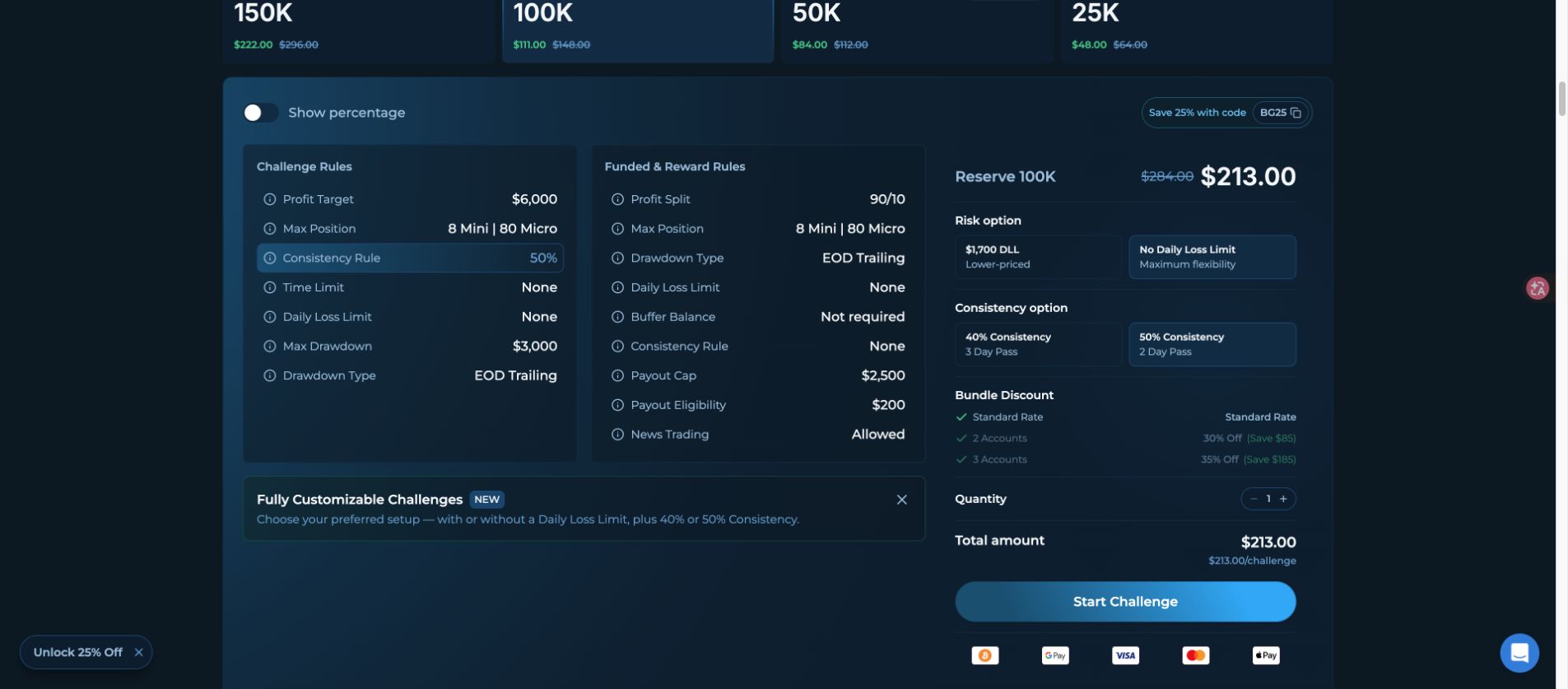
Multi-account savings are another calculation. The offer applies different discounts to additional accounts; it is not simply the first account’s price multiplied by five. Choose the exact quantity and compare the total in the futures PropFirm selector. Several accounts also multiply the money at risk and the work needed to satisfy each account’s payout rules.
EOD drawdown, daily loss limits and position size
EOD trailing drawdown moves the loss floor up after a new highest end-of-day balance. It does not follow each unrealized intraday high, and it does not move back down after a losing day. The active floor still applies during the session. A position can breach it before the day ends.
A daily loss limit is separate. Where the selected plan includes one, hitting it closes positions and pauses trading until the next trading day. That soft breach does not give you permission to cross the overall loss floor. On Standard $50K, for example, the daily limit is $1,000 and overall drawdown is $2,000.
Standard and Direct use fixed contract limits. Reserve and Express reduce position size when you enter the funded stage, then increase it with EOD profit. On $100K, their evaluation limit is eight minis or eighty micros, but the funded starting limit is three minis or thirty micros. Use the funded scaling schedule rather than treating the evaluation maximum as the first funded-day allowance.
Account stage matters for drawdown too. The current Express 100K selector shows a $3,000 evaluation drawdown and $2,500 funded drawdown. Its funded buffer is $2,600. Check the challenge and funded columns separately, particularly if comparing different account sizes.
How much can you request with $3,000 profit?
Here is a hypothetical comparison of four funded $50K accounts, each with $3,000 in profit. Assume the account has met its consistency, trading-day and other eligibility conditions. These are request ceilings before the 90% profit split and processing fees, not bank deposits.
Same $3,000 profit · four request ceilings
Standard $900
Keep $2,100 of the profit as buffer.
Reserve $1,500
Half the profit is below the $2,000 cap.
Express $900
The buffer leaves less than the $1,100 daily cap.
Direct $2,000
The first $3,000 profit goal is met; the cap limits the request.
Standard and Express require the $2,100 buffer to stay in the account. Reserve has no buffer, but the half-profit rule still limits what you can request. Direct also has no buffer, yet its profit goal, consistency test and payout cap all have to be satisfied.
After a payout, the drawdown floor locks at the starting balance plus $100 on all four plans. For a $50K account, that floor is $50,100. A withdrawal reduces the account balance while this floor stays fixed, so withdrawing more leaves less room for the next losing trade.
Direct $50K after the withdrawal
In this Direct example, the account has $900 above its loss floor after the deduction. The advertised $2,000 drawdown allowance does not reset after a withdrawal. Plan the next trade around the remaining gap and the daily loss limit; touching the overall floor breaches the account.
Reserve requires five qualifying winning days each cycle: $100, $150, $200 or $250 per day on $25K, $50K, $100K or $150K. For accounts purchased from July 27, 2026, payouts two through five also require new net profit of $500, $750, $1,000 or $1,250 respectively. Losing days reduce that net profit even when five winning days have already been recorded.
For current Express accounts purchased from September 2, 2026, the second request onward requires new profit equal to at least half the previous payout amount. After a $1,100 payout, that means at least $550 in new profit, with the buffer and other conditions still met. The daily caps are $600, $1,100, $1,500 and $2,500 across the four sizes. Daily eligibility is not a promise of a deposit every day.
For your actual model and size, use the Blue Guardian Futures payout limits and request planner. It separates all four sizes, Reserve winning days and new net profit, Express repeat-payout conditions, and Direct’s changing goals and caps.
Profit share, processing fees and the payout guarantee
The funded profit split is 90%, and the payout policy lists a separate 3% processing fee. The amount you request, your share after the split and the amount delivered are different numbers. Review the payout confirmation before treating a certificate amount as received cash.
Cryptocurrency payouts are capped at US$1,000 per request for all account types. Requests above US$1,000 must use Rise. Rise has no payment-method cap, but each plan’s payout caps, eligibility requirements and buffers still apply. First-time Rise users must complete onboarding and identity verification. Minimums depend on plan, account size and payment method. Select Rise or crypto in the payout dashboard and check the minimum shown for your account before submitting the request. Express also has size-specific minimums.
The published processing target is 24 business hours once a request is eligible and required information is complete. The payout guarantee applies to covered accounts, with an additional 10% profit share on an eligible delayed payout. Weekends, bank holidays, risk reviews, missing documents and Rise onboarding can pause or exclude the clock. This is a conditional processing policy, not a guarantee that money reaches your bank within one calendar day.
Before purchasing, check the Blue Guardian Futures and CFD country restrictions. The products have separate lists; KYC, payment ownership and U.S. CFD platform access are additional checks.
TradingView, DeepCharts and identity checks
Follow the Blue Guardian Futures login and platform setup guide to connect your issued account. Choose the Tradovate route if you want TradingView connectivity; that ecosystem also supports NinjaTrader. DeepCharts is the alternative for footprint, order flow and market-depth tools, using DXFeed. Its web version works on Mac; its desktop version is Windows-based. These are the futures platform choices, regardless of which CFD platform logos appear elsewhere on the brand’s website.
DeepCharts includes CME Level 1 data. The additional CBOT, COMEX and NYMEX Level 1 package costs $5 together, with Level 2 packages separately priced. A charting subscription or data upgrade is a different cost from the one-time prop account fee. The trading tools directory can help compare the tools you actually need.
Complete KYC from your own device and genuine network connection. Blue Guardian’s identity policy prohibits accessing or completing verification through a VM, remote desktop or proxy. Permission to run a Windows trading platform on a Mac does not mean that same virtual environment is suitable for identity verification. Use valid identification, the required live selfie and address evidence dated within three months; the payment method must belong to the registered trader.
Trading restrictions worth checking before purchase
News trading is allowed on the current evaluation and simulated funded plans, but not on Live. Trading hours run from 6:00 p.m. to 4:10 p.m. New York time, with automatic position closure at 4:10 p.m. Do not apply a CFD weekend-holding rule to this daily futures session.
Copying between accounts legally owned by the same trader is allowed, including your own external accounts. Copying another trader’s signals, coordinated group trading, hedging to offset accounts and fully hands-off bots are prohibited. Semi-automated tools require active monitoring and manual management. Under-ten-second trades must contribute less than 50% of total profit.
The risk-to-reward policy allows at most $5 of planned risk for each $1 of potential reward. A mental stop does not remove that limit. Trading near a CME price limit is also restricted: the firm prohibits trading within 2% of the applicable limit. Check the contract’s current exchange limits rather than using a fixed price from an old example.
Inactivity is measured in calendar days. Evaluations need a trade every 30 days. Funded accounts upgraded before October 10, 2026 retain the seven-day period; those upgraded on or after that date have ten days. The dated rule is in the current trading policy. Weekends and holidays count.
Five funded accounts and the Live review
You may hold unlimited purchased evaluations, but only five funded accounts can trade simultaneously. Additional qualifying or Direct accounts wait inactive until a slot is available. A copier does not combine their separate payout conditions into one.
Reaching a fifth payout places you in the Live Review Pool; promotion remains the risk team’s decision. Eligible funded accounts need at least one successful payout to contribute to the transition. A $50K contributes $2,000 of Live drawdown, so five eligible $50K accounts provide $10,000 combined drawdown, with a $0 starting balance. The limit is $15,000 per Live account; a larger combined amount can be split across two Live accounts.
Live has EOD drawdown, 90% profit share, daily payouts without caps, no daily loss limit and no consistency percentage. It prohibits news trading and hedging. If one household member trades Live, other household members cannot trade Blue Guardian simulated accounts. Other evaluations and ineligible funded accounts close at transition; the remaining drawdown determines whether their purchase fee qualifies for a refund.
The first Live transition can include milestone bonuses. Each of the three releases equals 25% of starting combined Live drawdown, triggered at cumulative net profit of half, one and one-and-a-half times that drawdown. Bonus withdrawals have their own five-winning-day condition. Alternatively, a one-time Live Buyout pays 50% of eligible combined starting drawdown and closes the accounts. It is chosen at transition, with a 28-day cooldown before buying another evaluation. Read the Live terms before treating promotion as extra spendable cash.
Is Blue Guardian Futures worth considering?
My preference remains a Direct 25K bundle if I am already planning to copy trades across several small accounts. If you only want one account, I would compare other firms first. Skipping evaluation is useful, but Direct’s first-payout consistency rule still requires distributed profit, and buying five accounts is a larger commitment even with a lower average price.
For the other routes, choose around the funded condition you can meet. Standard offers a less restrictive evaluation but adds funded consistency and a buffer. Reserve avoids funded consistency and the buffer, with winning-day and half-profit limits instead. Express suits smaller repeated requests after the buffer is established. Use the risk and drawdown calculators to test your trade size against the loss allowance, not the advertised account balance.
Public reviews include successful payments and support praise, as well as unresolved payout, verification and platform complaints. Some reports describe CFD products or older futures rules. They are useful questions to investigate, not proof that every account has the same result. Keep your selected terms, order confirmation and trade records, and use official support for account-specific decisions.
Compare Blue Guardian Futures with HDP
Choose Futures on the website. Standard, Reserve, Express and Direct currently receive 25% off with HDP. Select your platform, daily loss limit, consistency option and quantity before checking the total.
HDPView Blue Guardian Futures plans
Affiliate disclosure: a qualifying purchase through this link or code may earn a commission without adding to your price.
Blue Guardian Futures FAQ
Does buying Direct give me a real Live account?
It gives access to a simulated funded account after the agreement. Live is earned through a separate performance and risk review.
Which plan has no funded consistency percentage?
Reserve and Express. They still have other payout conditions, including winning days or a buffer.
Is Reserve always sold without a daily loss limit?
No. Select the daily-loss option you want. Removing it changes the price, and you can separately choose the available consistency setting.
Why does the price change after I choose options?
The size card shows a starting configuration. The order panel updates for daily-loss settings, consistency, platform and quantity.
Can I withdraw the whole profit once I reach the cap?
No. The cap is one limit, not your available balance. Buffer, percentage-of-profit, consistency, minimum and qualifying-day requirements can reduce or prevent a request.
Does a payout restore my original drawdown allowance?
The floor locks at your starting balance plus $100 after a payout. Subtract that floor from the remaining account balance to find the gap above the breach level. A larger withdrawal leaves a smaller gap for subsequent trades.
Does Express pay automatically every day?
You can request an eligible payout within the daily cap. Eligibility, approval and payment delivery remain separate steps.
Are resets covered by the account discount?
Standard and Express reset fees are fixed by size rather than the promotional code. Reserve uses its own purchase-linked reset calculation. Check the reset charge before comparing it with a new account.
Can I reactivate a failed funded account?
Eligible Standard, Reserve and Express accounts can be reactivated before the first payout, at most twice and within 30 calendar days of the breach. Reactivation is paid separately; this is not a general right to restore every failed account.
Can I use TradingView with DeepCharts credentials?
TradingView connectivity belongs to the Tradovate route. Choose that platform when purchasing if TradingView is the interface you want.
Can I complete KYC inside Parallels?
Complete identity verification directly on your personal device, outside a VM or remote desktop. A platform’s Windows requirements do not override the verification policy.
Do all funded accounts have seven days before inactivity?
Accounts upgraded before October 10, 2026 have seven calendar days. Those upgraded from that date have ten. Evaluations have thirty days.
Does the fifth payout guarantee Live promotion?
No. It is a route into the Live Review Pool. The risk team decides whether to promote you, and eligible accounts are handled under the Live transition rules.