
Apex Trader Funding offers EOD and Intraday futures evaluations, with a choice between paying an activation fee after passing or including activation in the purchase price. The current evaluations use one-time fees and can be passed in one trading day. Funded-stage rules then add qualifying profit days, consistency, contract scaling and a limit of six approved payouts per account.
HDP: 90% off the first month of Legacy evaluations. One Rithmic/WealthCharts 25K costs US$17.70; one 50K costs US$19.70. PA activation fees are separate. Legacy BOGO expired on October 30, 2026 at 00:00 Taiwan time. For BOGO purchases already made, both active evaluations renew separately from month two at 80% off regular prices under their purchase terms; cancel each separately to stop renewal. Intraday/EOD evaluations are 90% off, with one-time fees and a 30-calendar-day evaluation period.
EOD is the route worth comparing first if your trades often build open profit before pulling back. Its loss floor updates from closing balances instead of following every intraday high. Intraday evaluations can cost less and have no separate daily loss limit, but giving back open profit can leave much less room than the account balance suggests.
Apex's multi-account allowance is useful when you already have a trading process you can repeat. Each additional account brings its own fees, activity requirements and payout checks. Start the comparison with the number you can actually manage, rather than treating the maximum of twenty as a target.
Choosing between Apex and Tradeify? The Tradeify vs Apex comparison matches 50K EOD accounts and separates the evaluation price, cost after passing, first payout and remaining loss room.
What Apex Trader Funding actually provides
Apex is an Austin, Texas futures evaluation company founded by Darrell Martin in 2021. The company background describes that futures focus. Its evaluations and Performance Accounts, or PAs, operate in simulation. A later invitation into its Live department is a separate stage with broker onboarding and different rules.
Paying for a 50K evaluation does not deposit $50,000 into a brokerage account you own. You purchase access to a program with a defined profit target and maximum loss allowance. A current 50K evaluation gives $2,000 of initial maximum drawdown, which is the useful starting figure for sizing trades. The nominal balance alone says little about how many losing trades it can withstand.
Passing opens the opportunity to activate a PA of the same size, type and platform connection. The evaluation's accumulated profit does not become money available to withdraw from that new PA. You begin the funded-stage requirements there, and approved rewards can then produce a real payment. The User Agreement separates simulated balances from the right to receive a reward.
EOD vs Intraday: compare the same account and stage
| 50K condition | EOD | Intraday |
|---|---|---|
| Evaluation target / initial drawdown | $3,000 / $2,000 | $3,000 / $2,000 |
| Evaluation daily loss limit | $1,000 | None |
| Evaluation consistency | None | None |
| Evaluation maximum size | 6 minis / 60 micros | 6 minis / 60 micros |
| New PA starting size / DLL | 2 minis / $1,000 | 2 minis / $1,000 |
| Qualifying payout days | 5 days of at least $250 net | 5 days of at least $200 net |
| PA minimum balance to request $500 | $52,600 | $52,600 |
| PA drawdown floor | Updated from the highest closing balance | Follows the highest intraday balance, including open profit |
Both evaluation routes have thirty calendar days of access and no evaluation consistency percentage. The PA uses a separate 50% consistency requirement. Reaching an evaluation target in one session therefore says nothing about whether the next account can withdraw after one session.
The other current evaluation sizes are 25K, 100K and 150K, with targets of $1,500, $6,000 and $9,000 and initial drawdowns of $1,000, $3,000 and $4,000. PA position limits and payout conditions depend on the selected size. The futures PropFirm selector helps compare a specific plan without mixing its evaluation specifications with funded limits.
How EOD changes the room available during a trade
An EOD loss floor is recalculated after the session from the highest closing balance and applies during the next session. A temporary open-profit high does not immediately lift it. If a trade moves in your direction and retraces before you close, you have more flexibility than with a floor that follows that open-profit peak.
The existing floor still applies to open positions. If current equity touches it, the account fails or closes immediately. Recovering before the session ends does not undo the breach. The distinction is between when the floor moves and when it is enforced; EOD changes the first, not the second.
Intraday drawdown follows the peak including unrealized profit, and never moves down when that profit disappears. This can matter even on a profitable trade. The account may finish above its starting balance but have little distance left above the raised floor. Trading smaller reduces the dollar swings, while the trailing method continues to work the same way.
On a current 50K PA, the floor stops at $50,100. For EOD, that lock follows a highest closing balance of $52,100. Evaluation locking conditions are different, including a difference between Tradovate and the other connections. Use the EOD drawdown rules for the stage you are actually trading. The existing EOD drawdown guide in Chinese illustrates the distinction further.
Standard or No Activation Fee?
One-time PA activation fees in USD, per account: These are separate from Standard evaluation fees. Each PA activated from a five-pack is charged separately. Legacy PA payment options are separate and are not covered by this table.
| Size | Intraday Standard | EOD Standard | No Activation Fee option |
|---|---|---|---|
| 25K | US$89 | US$109 | US$0 |
| 50K | US$99 | US$129 | US$0 |
| 100K | US$129 | US$139 | US$0 |
| 150K | US$149 | US$159 | US$0 |
For example, one 50K Intraday Standard evaluation costs US$24.90, followed by US$99 to activate one PA: US$123.90 if passed on the first purchase. One 50K Intraday No Activation Fee evaluation costs US$79.90, with US$0 activation. Evaluation prices can change; check the selected configuration. Complete PA activation within seven calendar days of the dashboard marking the evaluation Passed.
With HDP, Intraday No Activation Fee evaluations currently cost US$79.90 for one 50K account, or US$345 for five (US$69 each). The 100K version costs US$99.90 for one, or US$445 for five (US$89 each). These are one-time evaluation fees with 30 days of access and US$0 PA activation after passing. Prices were checked on October 28, 2026; an advertised sale end date does not guarantee that these prices remain unchanged.
Standard has a lower evaluation price and a separate PA activation payment after passing. No Activation Fee charges more at purchase and includes that activation. The comparison needs both payments, using the same drawdown type, size, connection and purchase quantity.
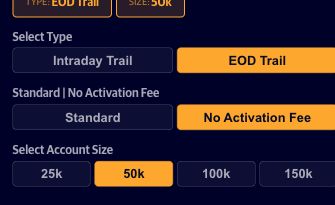
For Standard, add every paid evaluation attempt you expect to buy before passing, then the activation fee for the resulting PA. For No Activation Fee, add the higher purchase price for each attempt. A route that costs less when you pass immediately can cost more after several failed attempts. Your own completed trading record is a better basis for that comparison than the advertised fastest pass.
HDP applies to the eligible current offer. Check the evaluation price and activation price separately: a large percentage off the evaluation does not imply the same percentage off activation. A five-pack is also a different purchase from one account. Each evaluation in the bundle starts its access period together, including any account you leave unused.
Optional data and software can add costs. Basic Level 1 data is included, while added market-depth subscriptions have their own billing rules. Tradovate and WealthCharts add-on feeds need to be cancelled through the platform when no longer wanted; Rithmic's purchased depth data expires at month-end. Keep those charges separate from the evaluation's one-time fee.
For per-trade costs, the Apex commission comparison and calculator separates Tradovate, Rithmic and WealthCharts rates, including micro contracts and repeated trades across accounts.
Thirty calendar days to pass, then seven days to activate
The current EOD and Intraday access period includes weekends and holidays. It ends at 6 p.m. Eastern Time on day thirty. An unfinished evaluation expires without its balance carrying into another attempt. There is no extension or paid reset for these current products; continuing means purchasing a new evaluation.
Once you reach the target and satisfy the rules, Apex processes the result after market close. The account is marked Passed after 6 p.m. ET and appears in Passed Evals. The seven-calendar-day activation window starts from that official Passed status, rather than the moment an open trade briefly reaches the target.
In Passed Evals, use Purchase PA to activate the corresponding account. Standard requires the separate activation payment. An included-activation purchase still needs its activation process completed. PA creation can take up to six hours. Passing on the final access day still gives the full activation window; missing that window requires another evaluation pass.
The access and fee policy and PA activation timeline explain those two clocks. This matters if you reach the target shortly before a weekend or holiday: access expiry and activation expiry are different dates.
A funded account starts smaller than the evaluation
A 50K evaluation permits six minis, but a new current PA begins with two. Its tier determines both maximum position size and the daily loss limit. Closing profit of $1,500 moves the next session to three minis; $3,000 reaches four minis with a $2,000 DLL.
Tiers are assigned from the previous full session's closing balance and stay fixed during the next session. Crossing a profit threshold in an open trade does not immediately unlock a larger position. A later loss or withdrawal can also move the account down a tier. The PA scaling table is useful after withdrawals as well as after profitable sessions.
Reaching DLL liquidates positions and pauses trading until the next session; reaching the hard drawdown floor closes the account. The daily stop can therefore intervene before the entire distance to the hard floor is used. Set your own trade risk below the available limits rather than using automatic liquidation as an exit method.
Apex Trader Funding max contracts: evaluation vs PA
The evaluation allowance is larger than the size available when you first enter a current PA. These limits apply to both EOD and Intraday products; the PA ceiling is reached through scaling, not granted at activation.
| Size | Evaluation | Starting PA | PA ceiling |
|---|---|---|---|
| 25K | 4 | 1 | 2 |
| 50K | 6 | 2 | 4 |
| 100K | 8 | 3 | 6 |
| 150K | 12 | 4 | 10 |
Ten micro contracts count as one mini for this limit. Add positions across all open instruments: a 50K PA at its starting tier could hold one ES and ten MNQ, using its two mini-equivalents in total. That fills the allowance; switching symbols does not create a separate allowance for each market. The evaluation position-sizing policy uses the same ten-to-one conversion.
Current evaluations and PAs automatically reject an order that would exceed their position limit. A rejected order does not execute or create a position-size violation. The PA scaling policy still requires you to use the tier assigned for that session. Check each account separately when copying, because their tier allowances can differ.
Legacy uses a separate scaling rule. Its 50K PA starts at five minis and can unlock ten after the required end-of-day balance threshold; that is a different product from the current 50K PA above. The Legacy scaling policy also has its own violation penalties. Select the policy that matches the product name on your dashboard.
What a first 50K payout leaves behind
Assume an EOD PA earns $1,600 net on one day and $500 on each of four other days. These are hypothetical results after trading costs, with all other eligibility checks satisfied. Five days qualify, total profit is $3,600, and the balance is $53,600.
The best day contributes about 44.44%, below 50%. The first-request cap is $1,500, and that request leaves $52,100 in the account. At the current 100% approved payout split, the trader receives the full $1,500 before any payment-provider or bank costs.
$1,500 request → $1,500 trader share
Both bars start at the locked loss floor: $50,100
4 → 3 minis
DLL $2,000 → $1,000
That $52,100 retained balance is the payout safety net. The locked loss floor is $50,100, so the account has $2,000 of distance to the hard floor. It can remain a valid account below the payout safety net, but would need enough profit again to meet the next withdrawal conditions.
The withdrawal also reduces retained profit from $3,600 to $2,100. At the next closing-balance tier update, the allowance drops from four minis to three and DLL drops from $2,000 to $1,000. Check the updated tier before placing the next session's orders. The trading calculators can help separate a withdrawal deduction from the risk left afterwards.
Five profitable days do not guarantee the full payout cap
Qualifying days, consistency and available profit all apply together. Five EOD days of $250 create the required day count, but only $1,250 total profit. That is still short of the retained safety net plus the minimum withdrawal. The day counter can be complete while the payout button remains unavailable.
The largest profitable day must be below half of net cycle profit under the detailed payout eligibility wording. Losing days reduce that denominator. Exceeding consistency does not by itself close the PA; more net profit can restore eligibility. Once a payout is approved, the next consistency calculation uses profit earned after that approval.
Use the Apex consistency rule calculator to compare the strict 50% PA boundary with an active Legacy 30% requirement. It checks matching net profit periods and models how another completed day changes the total and the best day.
Each PA has its own sequential limits. The EOD payout policy and Intraday payout policy set different ladders for 50K:
| Approved payout number | EOD | Intraday |
|---|---|---|
| 1 | $1,500 | $1,500 |
| 2 | $1,500 | $2,000 |
| 3 | $2,000 | $2,500 |
| 4 | $2,500 | $2,500 |
| 5 | $2,500 | $3,000 |
| 6 | $3,000 | $3,000 |
After six approved payouts, the PA closes. Continuing in the simulated program requires qualifying through another evaluation. Keeping a large simulated surplus does not increase the sixth-request cap. That limit is worth considering before leaving money in an account purely to chase a higher nominal balance.
Twenty accounts share your trading, not their eligibility
The maximum is twenty active PAs across the household, including associated business accounts and different connections. Legacy, EOD and Intraday PAs count together. Evaluation accounts do not have that same twenty-account cap. Someone else at the same address does not create another separate allowance of twenty.
Apex permits copying your own manually entered orders under the agreement's conditions. The originating order must come from your real-time manual action, and the receiving accounts must exactly replicate it. Copying another person's trades, using third-party accounts or letting a strategy generate orders automatically falls outside that permitted setup.
Keep the setup within accounts you own and control, and obtain written confirmation before adding an external broker or firm's account. A tool advertising Apex compatibility does not establish that your particular routing is permitted. The existing Apex copy-trading setup guide covers the owned-Apex-account workflow and Tradovate group limitations, with actual setup screens.
Every account still has separate balances, tiers, qualifying days and consistency. A copied trade can fill differently or reach a risk limit in only one account. After entry and exit, check positions and working orders across the whole group; one flat account does not establish that the others are flat.
Trading platforms, session times and account activity
Choose Tradovate, Rithmic or WealthCharts when purchasing. Tradovate is the connection to compare if you want to place single-account trades from TradingView. The Apex TradingView setup guide covers activation, Demo login and account checks. Its native Group Trade functionality runs in Tradovate rather than turning TradingView into a group-order interface. Platform choice and copier choice are separate decisions.
The approved products include index, currency, energy, agricultural, metal and micro futures. A currency future is not a spot-forex account, and crypto futures are not a spot-crypto wallet. Confirm the actual contract and connection you intend to use, including any additional exchange data you need.
Normal simulated-account positions must be closed by 4:59 p.m. ET, with trading reopening at 6 p.m. Earlier agricultural closes and holiday schedules still apply. A Sunday evening session belongs to Monday's trading day. Apex Live has its own earlier 4:50 p.m. close, so a trader moving Live needs to change the daily routine too.
Current EOD and Intraday PAs must each record two days of at least $50 net profit in every rolling thirty-calendar-day period. The same activity policy applies to promotional Legacy accounts purchased after March 1, 2026. Logging in, breaking even or placing a small losing trade does not complete those profitable-day requirements.
This is separate from payout qualification. A $50 day can help keep the account active without counting as a 50K EOD payout day. If you remove an account from your copier while concentrating on others, its activity requirement continues running.
Receiving a payout and reading customer feedback
The Apex payout time and Plane receiving guide separates request review, first Plane invitation, dispatch and bank credit. Use its date worksheet to check the four-business-day invitation boundary and the separate seven-business-day PAID waiting window.
US residents use ACH bank payments. International users receive a Plane invitation after the first approved payout and complete their own bank setup there. Request submission, approval, dispatch and bank arrival are different steps. The payment guide describes a two-business-day review, then three to four business days for dispatch and bank processing afterwards; its overall five-to-eleven-business-day estimate is not a guaranteed arrival date.
The Trustpilot profile displayed a numeric score of 4.2 when checked, with both successful-payment reports and complaints about cost, account restrictions, support and Live onboarding. Individual reports cannot establish your eligibility or predict your payment. Current reviews can also describe different account types.
For a specific dispute, retain the purchased plan, account version, trade records, request details and the response identifying the applicable rule. Those details make a support inquiry more useful than a general accusation. Before paying, check your own country, identity and payment eligibility, including restrictions that apply while travelling.
Before relying on a Live transition, check the Apex Sim and Live country restrictions. The lists differ, and the overseas-residency, payment and travel conditions need checking for your own account stage.
What changes if Apex selects you for Live?
Apex can invite a trader into Live based on trading history and risk review. Three consecutive simulated withdrawals are a possible monitoring signal, not an automatic qualification. Selection ends the simulated stage: evaluations close, PAs deactivate and eligible positive PA balances enter the Bonus Vault tracking ledger.
The ledger is not cash available for immediate withdrawal. Potential bonuses depend on approved Live withdrawals and continued eligibility. Ordinary Live profit uses a 90% trader share; eligible Bonus Vault payments are calculated separately, with 40% in the first calendar month of approved Live payouts and 20% afterwards. The relevant Live account must remain active through that month's final day.
Live starts at $0 with $3,000 EOD drawdown, three minis or thirty micros and no Level 1 DLL. Daily requests require at least $500 and available profit above the $3,100 safety net. Additional accounts and higher limits require their own growth conditions. The Live program rules also separate broker eligibility from simulated eligibility.
Broker onboarding can decline a trader who was eligible for simulation. Declining the Live invitation also ends access to Apex's simulated services. The applicable final-reward route is different from withdrawing every remaining PA balance. If Live fails, the standard return route is the $199 requalification program, with one requalification account purchasable at a time, rather than simply continuing the old PA group.
Where Legacy fits, and when Apex is worth choosing
Legacy is a separate product family with recurring evaluation billing and its own trading and payout rules. Limited-time purchase offers can reopen it. Use the actual product name on the order and dashboard, because the current EOD/Intraday rules do not replace a Legacy account's conditions.
The Apex Legacy MAE guide explains the open-loss calculation, growth adjustment and violation review separately from payout consistency.
Apex is worth comparing if you want EOD futures drawdown and the option to copy your manual trades across several owned accounts. It asks you to manage activation choices, scaling, profitable days and capped payout cycles. If those tasks already fit your routine, the account allowance can be useful. If you are still changing your strategy from session to session, additional accounts multiply the same execution problem.
The main Apex guide in Chinese preserves the full signup, payout and series navigation. Use those operating steps once the specific configuration makes sense for your trading.
Choose your Apex configuration, then use HDP
Match the drawdown type, fee option, size and connection before checking the final total. Enter HDP for the eligible current offer.
HDPA qualifying purchase through this referral link may earn 全職奶爸 a commission without adding to your price.
Apex Trader Funding review FAQ
How many micro contracts equal one mini at Apex?
Ten micros count as one mini-equivalent. Add every open instrument together; for example, one ES plus ten MNQ uses two mini-equivalents.
What happens if an order exceeds my current contract limit?
Current EOD and Intraday evaluations and PAs reject the order before it executes, without a position-size penalty. Legacy accounts follow their own scaling and violation policy.
Can I pass an Apex evaluation in one day?
Current EOD and Intraday evaluations have no minimum trading-day count or evaluation consistency percentage. Reaching the target while respecting the rules can qualify in one session; the result is processed after market close.
Does the thirty-day period mean thirty trading days?
It means consecutive calendar days, including weekends, holidays and days you do not trade. Bundled evaluations share the purchase-based expiry, rather than starting when first used.
Can I reset a current EOD or Intraday evaluation?
No. A failed or expired current evaluation requires a new purchase. Legacy reset and subscription arrangements are separate.
Does hitting the daily loss limit fail the PA?
DLL pauses the session. Touching the hard drawdown floor closes the account, even if a separate DLL has not yet triggered.
Can EOD equity dip below the floor and recover?
No. The current floor is enforced during open trades. End-of-day calculation does not create permission to touch or cross that boundary intraday.
Can five small profitable days unlock a 50K payout?
They must reach the route's qualifying daily amount, and the balance, consistency and request minimum must also qualify. Completing the day count alone is insufficient.
Is the payout safety net the loss floor?
No. A locked 50K PA loss floor is $50,100, while its retained payout safety net is $52,100. Those levels control different things.
Do payout limits disappear after six requests?
Current EOD and Intraday PAs close after six approved payouts. They do not turn into an uncapped seventh-payout PA.
Can withdrawals reduce the contract limit?
Yes. Lower retained profit can put the next session in a lower tier. Check both the contract allowance and DLL after the closing-balance update.
Can each person in a household have twenty PAs?
The household total is twenty active PAs, including associated business accounts and different platforms. It is a combined cap.
Does Apex allow automated trading bots?
Strategies that independently submit, change or cancel orders are prohibited. The agreement permits limited tools and exact copying of the user's manual orders under its stated ownership and control conditions.
Can I continue trading after requesting a payout?
Yes, but manage the account as though the requested amount has already been deducted. Losing the required balance can invalidate the request.
Does regular trading automatically prevent inactivity closure?
The applicable PA policy requires two days of at least $50 net profit in every rolling thirty days. Trading activity without that result does not satisfy it.
Is a PA already a Live brokerage account?
No. A PA is simulated funded. A Live invitation brings separate broker approval, account limits, closing times and payout conditions.
By Yang · 全職奶爸. Updated October 15, 2026.